
The 30-second answer
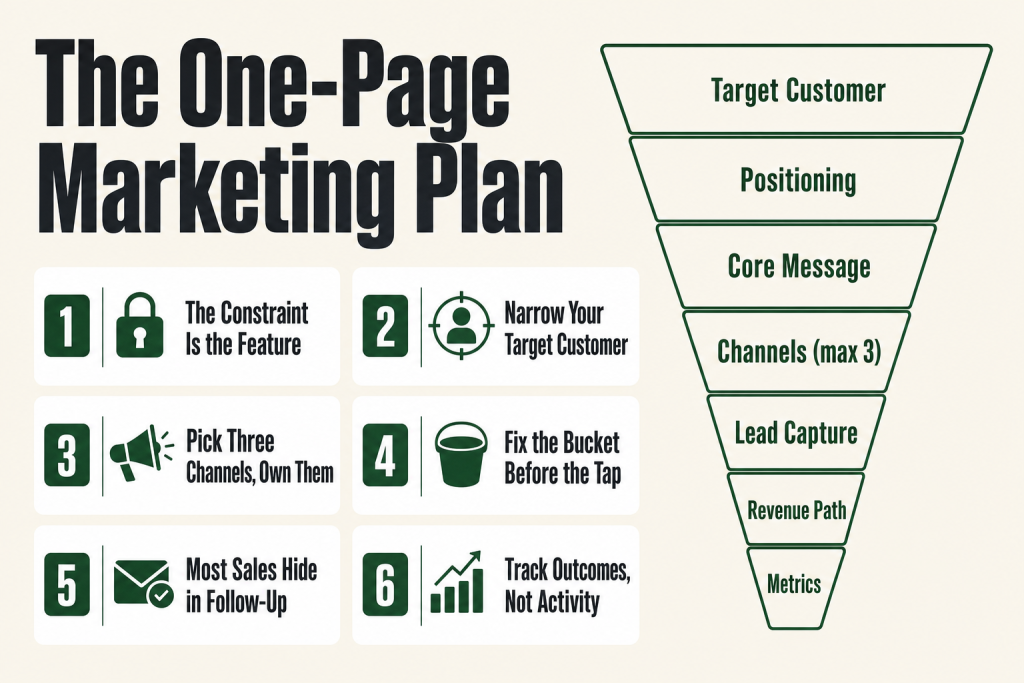
- What it is: A single-page document covering target customer, positioning, core message, channel choices, lead capture method, conversion path, and 3 to 5 KPIs.
- Why one page: Constraints force real decisions. A plan you can hold on one page is a plan you will actually use.
- Seven sections: Target customer, positioning and USP, core message, channels (max 3), lead capture and nurture, revenue path, and metrics.
- Time to complete: One focused afternoon if you have already done basic market research. Budget another session if you haven’t.
- What it does not do: It does not write your copy, build your funnel, or replace your judgment. You fill it in; you own every call.
- Review cadence: Revisit quarterly. Markets shift. A plan that was right in January may need a channel swap by April.
Take this fix into your next scenario. The free Builder’s Companion Kit collects the checklists and templates that pair with this guide — so next time, you start from a template, not a blank page. Grab it free →
- Why the One Page Constraint Actually Works
- Section 1: Target Customer (The Narrower, the Better)
- Section 2: Positioning and USP (Why You, Not the Other Person)
- Section 3: Core Message (What You Say and How You Say It)
- Section 4: Channels (Pick Three and Own Them)
- Section 5: Lead Capture and Nurture (How You Convert Attention Into a List)
- Section 6: Revenue Path (How a Lead Becomes a Sale)
- Section 7: Metrics (The 3 to 5 Numbers That Tell You If It’s Working)
- A One Page Marketing Plan in Practice: A Solo Consultant Example
- Four Mistakes That Turn a One Page Marketing Plan Into a Shelf Document
- How Often to Update Your One Page Marketing Plan
- FAQ
A one page marketing plan is not a watered-down strategy. It is a forcing function. One page forces you to make every decision you keep postponing: who exactly you are targeting, what you are actually promising them, which two or three channels you will commit to, and what numbers will tell you whether it is working. Most solo operators skip this document entirely, or they download a 40-tab spreadsheet template and never finish it. Both paths lead to the same place: random activity with no way to measure whether it is moving the business. This article walks you through a seven-section format you can complete in a single afternoon, plus the most common mistakes that turn a good plan into a shelf document.
Why the One Page Constraint Actually Works
A 20-page marketing plan looks thorough. It also takes weeks to write, gets read once, and sits in a folder. The one-page format wins for the opposite reason: the constraint is the feature.
When you only have one page, you cannot hide behind bullet-point hedging. You cannot list six target audiences and call it a strategy. You have to pick. That act of picking is where most small business marketing either succeeds or fails before a single dollar is spent.
Think of it like a restaurant menu. A 12-page menu looks impressive. A focused one-page menu tells you exactly what the kitchen is good at. Customers trust it more, and the kitchen executes it better. Your marketing plan works the same way.
The format described here has seven named sections. Each one forces a single hard decision. You will know you are done when every section has a specific, defensible answer, not a placeholder. If you find yourself writing “TBD” or “depends,” that section is not finished.
One honest caveat: this format does not do the thinking for you. AI can help you draft and pressure-test your answers, but the judgment on who your customer is, what you are worth to them, and which channels you can actually sustain belongs to you. Those calls stay in your hands. Do not outsource that to a tool and expect the plan to hold.
Section 1: Target Customer (The Narrower, the Better)
Start here. Every other section depends on this one getting done right.
“Small business owners” is not a target customer. “Female founders of product-based e-commerce businesses doing $200K, $800K in annual revenue who are running ads themselves for the first time” is a target customer. The difference is not semantic. It determines what you write, where you advertise, what problems you lead with, and what success looks like for a customer who buys from you.
Write three things in this section:
- Demographic anchor: Industry, business size, geography, or role. One specific slice.
- The problem they are actively trying to solve: Not the feature you provide. The situation they are in when they go looking for help.
- The result they want: What does success look like for them six months after working with you or using your product?
If you have not done formal audience research yet, that work feeds directly into this section. The article on doing market research with AI in an afternoon is a fast way to pressure-test your assumptions before you commit them to the plan. Use it to gather and synthesize signals faster, not to decide who your customer is. That decision is yours.
One mistake to avoid here: writing a target customer that describes everyone you have ever sold to. That is a customer history, not a target. Pick the segment that represents your best clients, the ones who got results, paid well, referred others, and did not drain you. Build the plan around more of them.
Section 2: Positioning and USP (Why You, Not the Other Person)
Positioning is the single sentence that explains why your specific target customer should choose you over every credible alternative. It is not a tagline. It is a decision-making tool you write for yourself.
A working positioning statement answers three questions in one breath:
- Who is it for?
- What do they get?
- Why can’t they get that exact thing somewhere else?
The “somewhere else” part is where most solo operators get vague. If your competitor can say the same thing about their business, your positioning is not a position. It is a description. Sharpen it until only you can honestly claim it. No AI tool can determine your real competitive differentiation for you. It can help you articulate what you already know, but you have to know it first.
Your USP (unique selling proposition) lives inside your positioning. It is the specific, provable claim that makes your promise credible. “We get results” is not a USP. “Our clients fill their first five coaching spots within 90 days or we extend for free” is a USP.
Section 3: Core Message (What You Say and How You Say It)
Your core message is the version of your positioning that a real human would actually say to another real human. It translates your USP into language that connects with your target customer’s real situation.
Write two things here:
- The headline message: One sentence that leads with the customer’s problem or desired result, not with your credentials or features. “Stop losing leads after the first call” is a message. “Award-winning CRM implementation services” is a credential.
- The supporting proof: One or two specific facts that back the headline. A stat, a case result, a before-and-after comparison. Something the reader can verify or at least believe without your help.
This section is where the plan connects to your actual copy. Every email subject line, landing page headline, and ad you write should trace back to this core message. If a piece of content cannot be connected back to it, ask whether it should exist at all.
AI tools are genuinely useful here for drafting message variations and testing different framings. What they cannot do is tell you whether a message is true to your brand or will land with the specific humans you are trying to reach. That read requires your judgment. The article on writing marketing copy with AI covers how to use AI drafts without losing your voice or letting the output go generic. The rule holds throughout: AI drafts, you judge and decide.
Section 4: Channels (Pick Three and Own Them)
This section is where most solo operators’ plans break down. The temptation is to list every channel where your target customer theoretically exists: SEO, email, Instagram, LinkedIn, YouTube, paid search, podcasts, referrals. That list is not a channel strategy. It is a recipe for doing everything badly.
Pick a maximum of three channels. Then commit to those three for at least one quarter before evaluating. Here is how to choose:
- Where does your target customer actually spend attention? Not where you wish they were. Where they demonstrably are, based on your research or your existing clients’ behavior.
- Which channels match your capacity and natural strengths? If you hate video, starting a YouTube channel is a path to quitting. If you write well and fast, content plus email is a sustainable engine.
- Which channels have a realistic payoff timeline for your revenue goal? SEO compounds over months. Paid ads can produce leads this week. Referrals depend on relationships you may already have. Match the channel to your current runway.
A note on channel selection: choose channels before choosing tactics. “We need TikTok” is a tactic looking for a strategy. “Our buyers research options on Google before deciding” is a strategic reason to invest in SEO and content. Start with the insight, then choose the delivery mechanism. That strategic call is yours to make, not something to hand off to a tool.
If email is one of your channels and you are starting from a small list, pair this plan with the first-100-subscribers plan to build the audience this plan needs to work.
Section 5: Lead Capture and Nurture (How You Convert Attention Into a List)
Traffic that does not convert into a contact you can follow up with is borrowed. The moment that visitor leaves, you lose them. This section of the plan documents how you capture leads and what happens next.
Write two things:
- Your lead capture mechanism: What specific offer or mechanism converts a stranger into a contact? A lead magnet, a free consultation booking, a newsletter opt-in with a clear value promise. One thing, not three.
- Your nurture sequence: What happens after they opt in? A welcome email sequence, a short email course, a check-in call sequence. Name the steps and the timeline.
The most common mistake here is treating lead capture as an afterthought. Operators spend weeks on social content or paid ads, drive real traffic, and then offer nothing to capture it. The visitor bounces. The spend evaporates.
AI can help you draft nurture email copy and subject line variations faster. The judgment calls, what problem to lead with, what tone fits your audience, when to ask for the next step, stay with you. For help choosing the right lead magnet, the article on lead magnets for service businesses walks you through picking the right problem and making the offer specific enough to convert.
Section 6: Revenue Path (How a Lead Becomes a Sale)
This section documents the specific steps between “first contact” and “paid customer.” It does not need to be a full funnel map. It does need to be explicit enough that a stranger reading your plan could trace the path.
Write the steps in plain language:
- Lead enters via [channel and lead capture mechanism].
- They receive [nurture sequence or direct offer].
- They are invited to [next step: call, purchase page, proposal, demo].
- Decision point: [what determines whether they buy?]
- If they don’t buy now: [follow-up process].
The “if they don’t buy now” step is the one most operators leave blank, and it is where real revenue hides. Most service business sales happen on the third to fifth follow-up, not the first. Document your follow-up process here so it actually happens.
If you are building this path from scratch, the guide to building a sales funnel without a team covers the full architecture.
Section 7: Metrics (The 3 to 5 Numbers That Tell You If It’s Working)
The last section of your one page marketing plan answers one question: how will you know if this is working?
Pick three to five metrics. Not fifteen. The goal is a short list you will actually check, not a dashboard you build once and forget. For most solo operators, a useful set looks something like this:
- Leads generated per month (from your primary channel)
- Lead-to-conversation rate (what percentage of leads take the next step)
- Conversion rate (conversations that become paying customers)
- Customer acquisition cost (total marketing spend divided by new customers that month)
- Revenue from marketing-sourced leads (to close the loop on whether the plan is producing)
Set a numeric target for each metric and a review date. “Increase leads” is not a metric. “30 qualified leads per month by Q1” is a metric. The number gives you something to act on when you miss it.
A common trap: tracking activity metrics instead of outcome metrics. Posting frequency, email sends, and page views tell you that you did the work. They do not tell you whether the work is producing revenue. At least two of your five metrics should connect directly to money.
If you are not sure how to read the numbers you are collecting, the article on reading your marketing data without an analyst gives you a practical framework for interpreting what you see and deciding what to change. The interpretation is yours. The article just helps you see it more clearly.
A One Page Marketing Plan in Practice: A Solo Consultant Example
Here is what all seven sections look like filled in for a real-sounding business. Use this as a model for the specificity level each section requires.
Business: Independent HR consultant serving founders of tech companies with 10 to 50 employees.
- Target customer: Seed-to-Series A tech founders, typically first-time managers, who need HR infrastructure (offer letters, comp bands, a people strategy) but are not ready to hire a full-time Head of People.
- Positioning: The only fractional HR consultant who builds a complete people infrastructure in 60 days, priced for startups that can’t justify a $150K head count.
- Core message: “Your first 20 hires define your culture. Don’t build that with no system.” Proof: 14 startups, average time-to-close-first-hire reduced by 3 weeks.
- Channels (3): LinkedIn content (2 posts per week), warm referrals from founders already served, and one SEO-focused article per month targeting “fractional HR for startups.”
- Lead capture and nurture: LinkedIn CTA drives to a free “First 20 Hires Checklist” download. After download: 5-email welcome sequence over 10 days, ending with a discovery call invitation.
- Revenue path: Discovery call, followed by a written proposal within 48 hours, followed by a 3-touch follow-up sequence if no response. Close is a 60-day retainer starting at $4,500/month.
- Metrics: 15 checklist downloads per month, 5 discovery calls booked per month, 2 new clients per quarter, CAC under $300, monthly retainer revenue tracked against a $9K/month target.
Notice what this plan does not include: a Facebook strategy, a podcast, a webinar, or a newsletter (yet). Those may come later. Right now, the plan is narrow enough to execute and specific enough to measure. That is the point.
Four Mistakes That Turn a One Page Marketing Plan Into a Shelf Document
Writing the plan is step one. The following mistakes guarantee it will not survive contact with week two.
Mistake 1: Vague targeting that includes everyone. If your target customer section could describe half of LinkedIn, go back and cut. Specificity feels risky because it feels like leaving money on the table. In practice, vague targeting produces vague messaging, which produces poor conversion rates, which costs you far more than the customers you think you are excluding.
Mistake 2: Too many channels. A plan with seven active channels is not ambitious. It is a prediction of mediocrity across all seven. Pick three channels, show up consistently for 90 days, then evaluate. Consistency beats coverage.
Mistake 3: No lead capture step. Running awareness-only marketing with no mechanism to capture a contact is like opening a tap with no bucket under it. Every visitor you send somewhere without capturing their information is a lead you are permanently giving away. Fix the bucket before you open the tap.
Mistake 4: Tracking activity, not outcomes. “We published 12 posts this month” is an activity log. “We generated 18 qualified leads from LinkedIn this month at a $47 cost per lead” is a marketing measurement. Only the second one tells you what to do next. Set up the outcome metrics before you start executing, so you are not reverse-engineering attribution four months in.
How Often to Update Your One Page Marketing Plan
Write the first version for a 12-month horizon. Review it quarterly. Update it when one of three things happens: a metric is consistently off by more than 20%, a channel stops producing, or your target customer shifts meaningfully.
Quarterly reviews do not mean quarterly rewrites. Most quarters, you are adjusting one or two numbers, swapping a channel that isn’t working, or sharpening the core message based on language your customers are actually using. The plan stays on one page. The discipline is keeping it current rather than letting it drift into fiction.
The one trap to avoid: updating the plan to match what you are already doing instead of updating what you are doing to match the plan. The plan should lead execution, not ratify it after the fact. If you find yourself writing down channel choices you already made without thinking about them, the plan has stopped doing its job.
FAQ
How long should a one page marketing plan be?
Literally one page. If you need two pages, you have not made enough decisions yet. The constraint is the mechanism: forcing everything onto one page forces you to choose what matters and cut what doesn’t. A printed page at readable font size, or a single-screen document, is the target.
What is the difference between a one page marketing plan and a full marketing plan?
A full marketing plan documents everything: competitive landscape, detailed personas, channel playbooks, content calendars, budget breakdowns by quarter. A one page marketing plan captures only the decisions that drive execution: who, what, where, how you capture leads, how you close, and what you measure. The one-pager is your compass. The full plan is the map. Most solo operators only need the compass.
Can I use AI to write my one page marketing plan?
AI can help you draft sections, pressure-test your positioning, and suggest message framings. What it cannot do is make the judgment calls at the center of the plan: who your real target customer is, what your actual competitive differentiation is, and which channels you can genuinely sustain. Those answers require context, experience, and honest self-assessment that only you have. Use AI to accelerate the drafting and sharpen your thinking. Make every substantive decision yourself, and review every AI output before it goes into the plan.
How do I know which marketing channels to put in my plan?
Start with where your target customer actually pays attention, not where you wish they were. Then filter by your own capacity and natural strengths. If you write quickly, content plus email is sustainable. If your buyers decide based on peer referrals, a referral program and direct outreach may outperform any content channel. Match the channel to the customer’s behavior first, your capacity second.
How often should I update my one page marketing plan?
Review it every quarter. Update it when a metric is consistently more than 20% off target, when a channel stops producing, or when your customer definition shifts. Most quarterly reviews only require small adjustments. A full rewrite usually signals that the original plan was built on assumptions rather than evidence.
Do I need a marketing budget to build a one page marketing plan?
You need to include a budget section in the plan even if the number is small. Zero-dollar marketing budgets exist, but they typically mean you are trading time for money at a very unfavorable rate. Document what you are spending, including the value of your own time on marketing tasks, so you can measure whether the return justifies the investment.
Sources:
Sources consulted for this article include: Visme, “One Page Marketing Plan: How to Write Yours in 6 Steps” (March 2026); Leadpages, “The Ultimate 1 Page Marketing Plan” (March 2026); Mitch Wilder, “10 Marketing Plan Mistakes Draining Your Budget” (July 2026); Llamaleadgen, “How to Create a One Page Marketing Plan” (June 2026); Growthink, “One-Page Marketing Plan + Template” (March 2026); Women Conquer Biz, “5 Common Marketing Mistakes Small Business Owners Make” (May 2026); FourPoint Business, “Why Small Business Marketing Fails” (December 2025); Enji, “How to Create a One Page Marketing Plan” (January 2026); Simon and Schuster publisher page for Allan Dib’s The 1-Page Marketing Plan 2025 updated edition; Bloombit summary of The 1-Page Marketing Plan. All platform-specific claims have been verified against current live sources. No invented UI labels or defaults appear in this article.
Brian Kasday spent forty years in direct-response marketing before rebuilding the whole operation as a one-person shop. He writes The Operator’s Library — including “Build a Complete Marketing Department” — for operators who’d rather build it themselves than wait on someone else.
Get the Builder’s Companion Kit — the free checklists and templates that pair with this guide: mmsvegas.com/resources.
This guide handles one marketing job. Build a Complete Marketing Department builds the whole department. See the manual →
More Marketing guides
Free · Marketing Operator Toolkit
Running marketing on your own?
Get the free toolkit — the templates and the expensive mistakes behind a one-person marketing department, plus a note when this guide changes.
Get the free toolkit →