
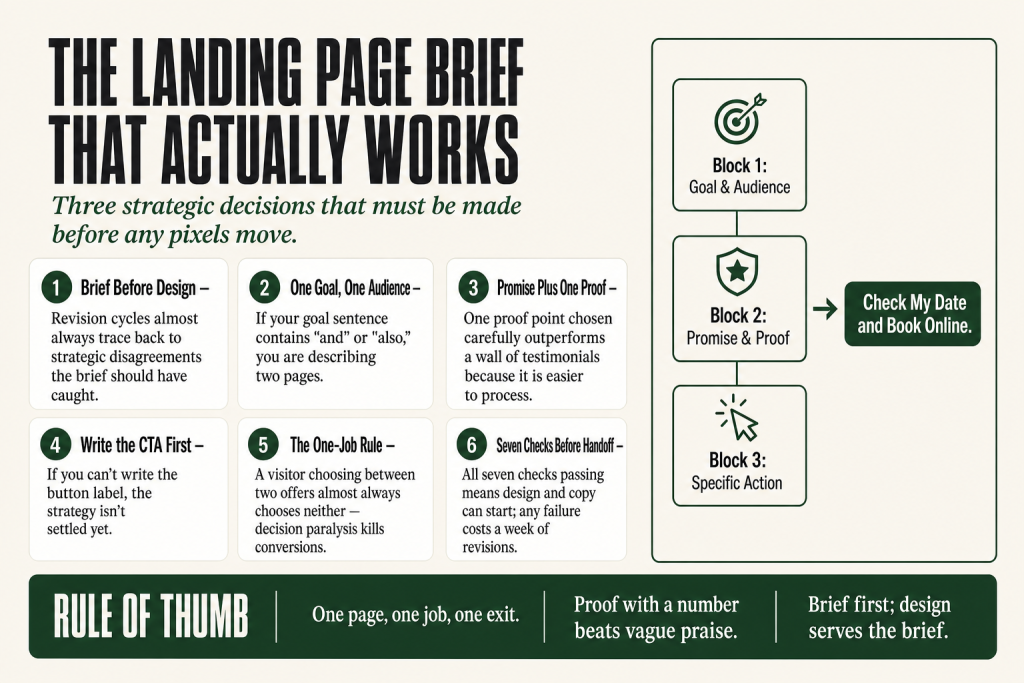
The 30-second answer
- One goal, one audience. Name the specific person arriving on this page and the single outcome you want. A page trying to do two things does neither well.
- One core promise plus its proof. State the result the visitor gets and back it with one concrete proof point: a number, a case result, or a named credential.
- One specific action. Write the CTA button label word-for-word before you brief anyone. If you can’t write it yet, the strategy isn’t settled.
- The one-job rule. If a second goal creeps into the brief, it needs its own page, not a section on this one.
- Fill it in first, design second. Every design decision should serve the brief, not the other way around.
Take this fix into your next scenario. The free Builder’s Companion Kit collects the checklists and templates that pair with this guide — so next time, you start from a template, not a blank page. Grab it free →
- Why the Brief Comes Before the Design Brief
- Block 1: The Single Goal and the Specific Audience
- Block 2: The Core Promise and Its Proof
- Block 3: The Specific Action, Written Word for Word
- Worked Example: A Filled-In Landing Page Brief Template for a Real Offer
- The One-Job Rule for a Landing Page Brief Template
- How to Use the Brief as an AI Handoff Document
- What to Check Before You Hand Off the Brief
- FAQ
A landing page brief template sounds like extra paperwork until you’ve watched a designer spend three days building a beautiful page that answers the wrong question for the wrong person. The brief isn’t bureaucracy. It’s the one document that forces you to make three strategic decisions before any pixels move: who this page is for and what you want them to do, the single promise you’re betting the page on and the proof that backs it up, and the exact action you’re asking the visitor to take. Skip it and you’re handing off a guessing game. Fill it in and you’re handing off a job description the page can actually execute.
Why the Brief Comes Before the Design Brief
Most small operators hand a designer a rough idea and a logo. What they get back is a page that looks professional and converts like a brochure. The reason isn’t the designer’s fault. It’s that nobody settled the strategic questions before the creative work started.
Think of the brief as the foundation slab. You don’t argue about paint colors before you pour concrete. The brief locks in three things that no designer, copywriter, or AI tool should be deciding for you: the goal and audience, the promise and its proof, and the specific action. Once those are settled, every design and copy choice has a clear standard to meet.
The brief also protects your time. Revision cycles almost always trace back to a strategic disagreement that should have been resolved in the brief. Catch it on paper in twenty minutes and you avoid two rounds of revisions that cost you a week.
This applies whether you’re handing off to a freelancer, feeding a prompt into an AI writing tool, or building the page yourself. The judgment about what the page should accomplish stays with you. The brief is how you document that judgment before execution starts.
Block 1: The Single Goal and the Specific Audience
Start with two sentences, not a paragraph. One names what you want the visitor to do. One describes who that visitor is.
The goal sentence follows this pattern: “This page exists to get [specific person] to [specific action].” That’s it. If you find yourself writing “and also,” stop. You’re describing two pages.
A clear, single conversion goal is the structural principle that separates a landing page from a homepage. Your homepage can serve multiple audiences and link to a dozen destinations. This page serves one person and points to one exit.
The audience sentence names the person at the moment they arrive, not their demographic profile. “A service-business owner who just saw my Facebook ad about booking more clients” is more useful than “small business owners, ages 35-55.” The more precisely you describe the arrival moment, the better the headline writes itself.
If you’re unsure how to sharpen the audience description, your market research already has the answer. See how to do market research with AI in an afternoon for a fast way to pull exact language from the people you’re targeting.
What to write in your brief
- Goal: This page exists to get __________ to __________.
- Audience: The person arriving is __________, and they just came from __________ (ad / email / search result).
- Success metric: I’ll know it’s working when __________ (form fill rate, booking rate, purchase rate).
Block 2: The Core Promise and Its Proof
The promise is the one result the visitor is buying into by taking your action. Not a list of features. Not three benefits. One result, stated in plain language that the visitor would actually use.
A useful test: read your promise sentence aloud. If it sounds like something from an industry conference, rewrite it in the words a satisfied customer would use to describe the outcome to a friend. That version is your promise.
The proof is the single most credible thing you can put next to that promise. Proof options, in rough order of credibility for most service businesses:
- A specific result with a number (“booked 12 new clients in 6 weeks”)
- A named client testimonial that describes the outcome, not just the experience
- A before/after case result with context
- A relevant credential or certification that directly supports the promise
- A risk-removal mechanism (a guarantee, a free trial, a sample session)
One proof point, chosen carefully, outperforms a wall of testimonials because it’s easier to process. Pick the one that best matches the specific audience you named in Block 1. A testimonial from someone who looks like your arriving visitor is worth more than five from people who don’t.
Your promise and proof are essentially the skeleton of your headline and subheadline. If you can’t write them for the brief, you can’t brief a copywriter either. And if you can write them, you’re more than halfway to writing the page yourself. The sales page writing guide picks up from exactly this point.
What to write in your brief
- Core promise: After taking my action, the visitor will __________.
- Best proof point: I can prove this because __________.
- Proof format: (testimonial / case result / stat / guarantee / credential)
Block 3: The Specific Action, Written Word for Word
This is the block most operators skip or leave vague. “Get a quote” or “Learn more” or “Contact us” are placeholders, not CTAs. They don’t tell the visitor what happens next or why it’s worth doing.
Write the CTA button label before you hand off the brief. If you can’t write it, the strategy isn’t settled yet. The button label forces clarity because it has to answer three things in three to seven words: what the visitor gets, what they do, and what happens immediately after they click.
Compare these:
- “Submit”, tells the visitor nothing
- “Book My Free Strategy Call”, tells them the format (call), the price (free), and the purpose (strategy)
- “Download the Inspection Checklist”, tells them exactly what arrives in return
The action block also includes any friction-reduction copy that sits below the button: a privacy note, a “no credit card required” line, a cancellation policy. Write those here too. They belong to the action, not to the design.
One more thing to settle: how many places the CTA appears on the page. For a short page (under 600 words of visible copy), once is enough. For a longer page, repeat the same CTA. Never swap the label mid-page. Consistency removes the micro-decision of “wait, is this the same thing?”
What to write in your brief
- CTA button label (exact words): __________
- What happens after the click: __________ (calendar booking / form confirmation / download link / checkout)
- Friction-reduction copy below the button: __________
- Number of CTA placements on the page: __________
Worked Example: A Filled-In Landing Page Brief Template for a Real Offer
Here’s what a completed brief looks like for a real small-business offer. The business is a home-inspection company running Google ads targeting first-time buyers searching for inspectors in their metro area.
LANDING PAGE BRIEF
Page URL (planned): /book-home-inspection/
Traffic source: Google Search ads, keyword group “home inspector [city]”
Block 1: Goal and Audience
- Goal: This page exists to get a first-time homebuyer under contract to book a home inspection appointment.
- Audience: A buyer who just searched “home inspector [city],” clicked our ad, and has a closing deadline within 14 days. They’re anxious about missing something serious in the house.
- Success metric: Booking form completion rate. Target: 15% of page visitors book.
Block 2: Core Promise and Proof
- Core promise: After booking, the buyer gets a same-week inspection with a written report in 24 hours, so they don’t miss their closing window.
- Best proof point: “We’ve completed 1,400+ inspections in [city] and deliver every report within 24 hours, or the inspection is free.”
- Proof format: Stat plus guarantee.
Block 3: The Specific Action
- CTA button label: Check My Date and Book Online
- What happens after the click: Inline calendar (Calendly or equivalent) showing available slots, followed by a short booking form collecting address and contact info.
- Friction-reduction copy: “Takes 2 minutes. No payment until after your inspection.”
- CTA placements: Two, once in the hero section, once after the proof section.
What this page does NOT do: It does not link to the company’s About page, service menu, or blog. It does not promote commercial inspections. It does not ask for an email list opt-in.
Notice that the “what this page does NOT do” line is part of the brief. Scope creep is easiest to stop before the design file opens. Write the exclusions down.
The One-Job Rule for a Landing Page Brief Template
Every time a second goal appears in a brief, someone is about to build two pages into one. It never works the way the operator hopes.
The usual argument is efficiency: “While we have them here, let’s also show them our other services.” The problem is that a visitor who arrived for one specific reason and finds themselves choosing between two offers almost always chooses neither. Decision paralysis is the conversion killer that looks like a traffic problem.
The rule is simple: one page, one job. If a second goal is genuinely worth pursuing with a dedicated page, give it one. That means two pages, two briefs, two sets of metrics. That’s not more work. That’s clarity about what each page is supposed to accomplish, which makes every downstream decision faster.
The same logic applies to navigation. A landing page that includes the site’s main navigation is giving the visitor ten escape routes. Removing navigation from a dedicated conversion page is standard practice precisely because every extra link is a vote against the primary action.
When you’re building your funnel, the pages that follow a landing page (thank-you pages, upsell pages, email sequences) each get their own brief too. They’re downstream jobs, not extensions of this one. The solo operator’s funnel-building guide covers how to sequence those pages once each one knows its job.
How to Use the Brief as an AI Handoff Document
A completed brief is one of the cleanest inputs you can give an AI writing tool. Feed it the three blocks and ask for a headline, subheadline, and hero-section body copy. You’ll get a much tighter first draft than you would from a vague prompt like “write a landing page for my inspection business.”
That said: the brief is your judgment, and the AI output is a draft. The AI doesn’t know whether the proof point you chose is actually the most credible one for this specific audience. It doesn’t know whether your calendar booking flow creates friction after the click. Those calls stay with you.
What the brief does is cut the back-and-forth. Instead of three rounds of “this isn’t quite right,” you can evaluate the first draft against a written standard: Does this headline reflect the promise in Block 2? Does this CTA match the exact label in Block 3? Binary checks against a brief are faster than subjective reactions to a draft.
If you’re still developing your process for working with AI on copy, the solo operator’s AI copywriting method walks through how to structure those prompts so the output is actually usable.
The brief also serves as institutional memory. When you build the next version of this page in six months, you have a written record of the original strategic intent. You’ll know whether the changes you’re considering are improvements or just drift.
What to Check Before You Hand Off the Brief
Run through this list before the brief leaves your desk.
- One goal only. Read the goal sentence. If it contains “and” or “also,” cut it to one.
- Audience arrival moment is named. You’ve described where the visitor came from, not just who they are.
- Promise passes the friend test. Would a satisfied customer actually say this to a friend? If it sounds like marketing copy, rewrite it.
- Proof is specific. A number, a name, or a guarantee beats a vague claim every time. “Clients love us” is not proof.
- CTA label is written out. Exact words, not a direction like “something about booking.”
- Post-click experience is described. The brief says what happens after the click. If you don’t know, find out before you hand off.
- Exclusions are listed. You’ve named at least one thing this page will not do or link to.
That’s seven checks. If all seven pass, the strategic decisions are settled. Design and copy can start. If any one fails, you’re not ready yet, and finding that out now costs you twenty minutes instead of a week of revisions.
Once the page is live, you’ll want a way to track whether the action you specified is actually happening at the rate you projected. That’s where a clean analytics setup matters. The UTM naming convention guide shows you how to tag your traffic sources so you know which campaign is feeding this page, not just that someone visited.
FAQ
how long should a landing page brief be
One page, ideally under 400 words. If it’s longer, you’re writing a creative brief, not a strategic one. The brief settles three decisions: goal and audience, promise and proof, and the specific action. Everything else belongs in a separate document or in the design review.
can I use a landing page brief template for an AI page builder
Yes, and it works well. Paste the three blocks into your prompt and the output is far more targeted than a generic page description. You still need to review the result against the brief yourself. The AI generates the draft; you verify whether it actually reflects the promise and CTA you specified.
should a landing page have more than one CTA
You can repeat the same CTA multiple times on a longer page, but every instance should use identical button copy. Multiple different CTAs compete with each other and reduce conversions. One job, one label, repeated as needed.
what is the difference between a landing page and a sales page
A landing page is typically short and focused on a single low-friction action like booking a call, downloading something, or starting a trial. A sales page is longer and designed to move a cold visitor all the way to a purchase decision, handling more objections along the way. Both need a brief, but a sales page brief will have more proof points and a longer objections list.
do I need a separate landing page for every ad
Not necessarily for every individual ad, but generally yes for every distinct audience segment or offer. If two ads make different promises to different people, sending both to the same page breaks the message match and hurts conversions. The brief helps you decide: if the goal, audience, and promise are identical, one page works. If any of the three differ, you need a separate page.
what proof works best on a landing page for a service business
A specific result with a number or a named client outcome almost always outperforms generic praise. “We helped a 3-location HVAC company book 40% more service calls in 90 days” is more credible than “our clients love working with us.” Choose proof that matches the exact outcome your arriving visitor wants.
Sources:
- VWO, “How to Improve Conversion Rate Optimization for Landing Pages”, one clear goal principle, live at vwo.com
- ZoomInfo Pipeline, “Landing Page Conversion Rates: 2026 Benchmarks”, single CTA and conversion rate data, live at pipeline.zoominfo.com
- UForocks, “10 Landing Page Optimization Best Practices for 2025”, single CTA and decision paralysis, live at uforocks.com
- Mane Digital, “Landing Pages Best Practices”, navigation removal rationale, live at manedigital.com
- LanderMagic, “9 Conversion Rate Optimization Best Practices”, message match and social proof placement, live at landermagic.com
Brian Kasday spent forty years in direct-response marketing before rebuilding the whole operation as a one-person shop. He writes The Operator’s Library — including “Build a Complete Marketing Department” — for operators who’d rather build it themselves than wait on someone else.
Get the Builder’s Companion Kit — the free checklists and templates that pair with this guide: mmsvegas.com/resources.
This guide handles one marketing job. Build a Complete Marketing Department builds the whole department. See the manual →
More Marketing guides
Free · Marketing Operator Toolkit
Running marketing on your own?
Get the free toolkit — the templates and the expensive mistakes behind a one-person marketing department, plus a note when this guide changes.
Get the free toolkit →