
Last updated: July 2026
A minimum viable product is the smallest thing you can put in front of real customers to find out whether your most dangerous commercial assumption is actually true.
Most small-business operators encounter the MVP concept and promptly misapply it. They build something modest, call it an MVP, launch it, and then judge it by whether it succeeded as a product, when the question they should have been asking is whether it answered the question they were afraid to ask. That’s not a semantic quibble. It changes everything about what you build, how long you give it, and what you do next.
The idea matters because the single most expensive mistake a small operator can make isn’t a bad hire or a wasted ad budget. It’s spending four months and real money building an offer, service, or product that customers don’t actually want in the form you imagined. A minimum viable product is the antidote, not a startup buzzword, not a reason to ship something embarrassing, but a structured discipline for spending the minimum possible to find out what’s true before you bet big on it.
The idea in 30 seconds
- A minimum viable product is the smallest credible version of an offer you can test with real customers before committing to a full build.
- Its purpose isn’t a polished launch, it’s to validate or kill your riskiest commercial assumption as cheaply and quickly as possible.
- The word viable is the one most operators get wrong: it means good enough to elicit a real signal, not good enough to be proud of.
- MVP formats range from a landing page and a video to a concierge service you run entirely by hand, code is optional.
- A failed MVP isn’t a failed business; it’s cheap intelligence that saves you from an expensive wrong turn.
- The operator’s job is to identify one hypothesis, design the smallest test for it, and act on what the market tells you, not argue with it.
Where the Minimum Viable Product Came From
Frank Robinson coined the term in 2001. He was co-founder and president of SyncDev, a product development consultancy, and he wasn’t thinking about Silicon Valley startups, he was solving a capital allocation problem for his clients. His definition was economic from the start: the MVP is the right-sized product for your company and your customer, big enough to cause adoption, satisfaction, and sales, but not so big as to be bloated and risky. Technically, it’s the product with maximum ROI divided by risk. Not ‘build something small,’ but ‘find the point where what you learn justifies what you spend.’
Robinson’s framing also introduced what he called synchronous development, running product development and customer development in parallel, so the build decision is already de-risked before the roadmap locks. That’s the part most people forget when they cite him.
Steve Blank picked up the thread in 2005 with The Four Steps to the Epiphanywhich introduced the Customer Development methodology and pushed entrepreneurs to test assumptions with real customers before committing to a full build. Blank didn’t coin ‘minimum viable product,’ but he gave Robinson’s instinct a systematic framework. His core principle: there are no facts inside your building, so go get outside it.
Then in 2011, Eric Ries brought the concept to a mass audience in The Lean Startupreframing it around the Build-Measure-Learn loop. Where Robinson’s MVP answered a scoping question, given we’re building this, what’s the optimal amount to build? Ries’s version asked something earlier and cheaper: how do we find out whether anyone wants this at all? That shift opened the door to lighter experiments: landing pages, concierge tests, explainer videos with nothing built behind them.
The term has since been stretched to mean almost anything. The most common misreading, fewer features, same purpose as the finished product, is what produces mediocre launches masquerading as strategic tests.
What a Minimum Viable Product Actually Tests
Strip away the jargon and the concept reduces to one question: what’s the riskiest thing you’re assuming, and what’s the cheapest way to find out if you’re right?
For most small-business operators, value risk, will anyone pay for this? is the one that kills them. It’s also the one that’s cheapest to test, if you’re willing to test it honestly.
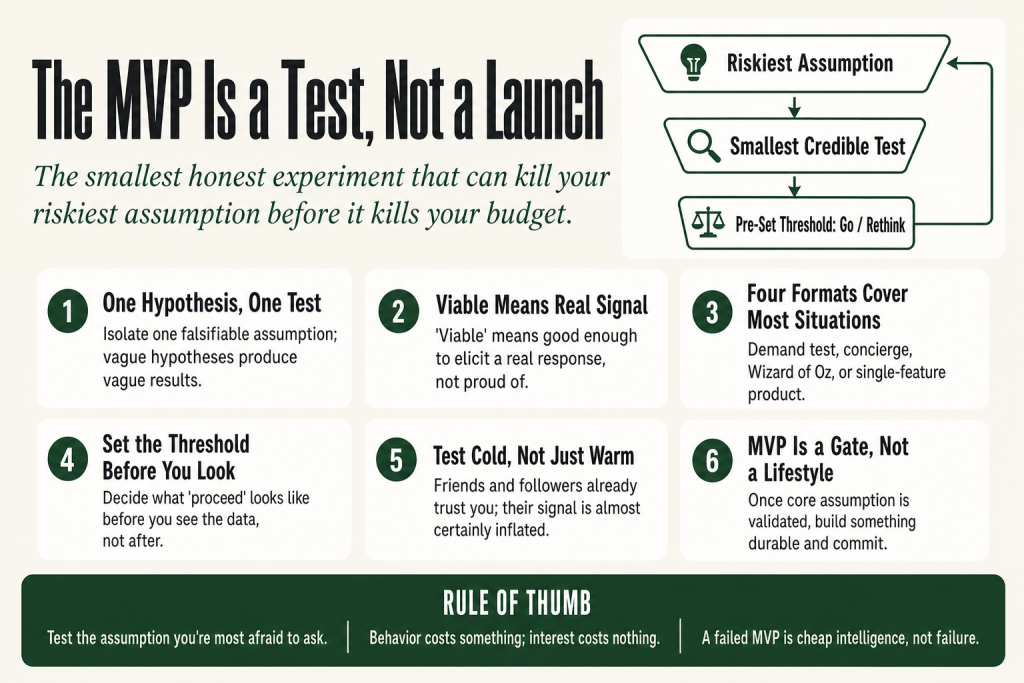
A good minimum viable product test comes down to three things:
- One hypothesis. Not ‘will people like this?’ but something falsifiable: ‘Will a local professional services buyer pay $X/month for Y outcome when Z is the alternative?’ Vague hypotheses produce vague results.
- The smallest credible test. Credible means the customer’s response reflects a real purchasing decision, not just politeness, not just interest, but behavior that costs them something: time, money, attention, commitment.
- A predetermined threshold for yes or no. Decide before you run the test what result means ‘proceed’ and what means ‘rethink.’ If you wait until after to interpret the numbers, you’ll rationalize almost any result into a green light.
The word viable deserves more respect than it gets. Robinson’s original framing is that the MVP is the right-sized product, big enough to cause adoption, satisfaction, and sales, but not so big as to be bloated and risky. Viable means the customer gets something real enough to give you a real response. A landing page with no actual product tests demand. A concierge service where you do the work by hand tests whether the outcome produces satisfaction and repeat purchase. Both are legitimate, but they answer different questions, and conflating them is where operators get lost.
The Four Minimum Viable Product Formats That Cover Most Operator Situations
There are really four formats that cover most small-business situations. They’re not ranked by sophistication, they’re ranked by what question they answer.
The Demand Test (Landing Page / Video / Pre-Order)
You describe the thing before it exists and measure whether people take action to get it. Drew Houston posted his first Dropbox demo video to Hacker News on April 5, 2007, as part of his Y Combinator application. A second video, posted to Digg and Reddit during the Spring 2008 private beta launch, drove the waitlist from 5,000 to 75,000 signups in a single day, no paid advertising, no finished product. For a small operator, the equivalent is a simple page describing the new service, a small ad driving cold traffic to it, and a ‘join the waitlist’ or ‘book a call’ button. If 0% click through, you have your answer before you’ve built anything. A financial planner testing a new ‘tax optimization sprint’ package can run this for $400 in Facebook spend. A gym owner wondering whether semi-private training has an audience can put up a page and find out in two weeks, not two months of planning.
The Concierge MVP
You deliver the service manually, at human scale, with the customer knowing that’s what you’re doing. On January 12, 2013, the four DoorDash founders launched PaloAltoDelivery.com, a basic website with PDF menus from eight local restaurants and their personal cell numbers for orders, then personally drove deliveries nights and weekends. The manual execution proved the concept before a single line of platform technology was built. For a service operator, this might look like: offer a new advisory package to three clients, do all the work by hand, even the parts you’d eventually automate, charge the real price, and see whether clients buy, renew, and refer. The manual work reveals exactly which parts of the delivery actually matter and which were assumptions you made at your desk.
The Wizard of Oz MVP
Customers interact with what looks like a finished product, but humans are running it behind the scenes, and the customer doesn’t know that. In 1999, Nick Swinmurn photographed shoes at local stores, posted them on his website, and when orders came in, he’d drive back to the store, buy the shoes, and ship them himself. Customers had no idea there was no warehouse. For a small operator today, this format fits well when you’re testing whether automated delivery would change user behavior, you simulate the automation before building it. A meal-prep subscription delivered by hand. A ‘client portal’ that’s actually an email thread with a VA. The customer gets a real result; you get real signal.
The Single-Feature Product
You build only the one capability that is the core of the value proposition, nothing else. For an operator, this might mean launching a subscription box with a single curated theme before building out a full selection engine, or offering a single coaching format before building a full curriculum. The instinct to add more before launch is almost always wrong at this stage. Every feature you add before the test is an assumption stacked on top of an assumption.
Which format you choose depends entirely on the assumption you’re testing, not on what looks most impressive at the pitch deck stage.
Why the Minimum Viable Product Approach Works
Every offer you build rests on a stack of assumptions, about who wants it, what they’ll pay, what problem they’re actually trying to solve, and whether your solution is the right shape for that problem. Most of those assumptions feel obvious from the inside and turn out to be wrong in practice. The MVP approach forces you to test the most dangerous one before the others.
What makes it particularly useful for small operators is that it breaks the psychology of sunk cost before that cost accumulates. Once you’ve spent six months and $40,000 building something, you will rationalize launching it even if early signals are mixed. You’ve invested; you’re committed. A minimum viable product run before that investment is locked in means you’re still making decisions with open hands, you can pivot, scrap, or redirect without grieving a project you’ve poured yourself into.
The second reason it works is that it replaces opinion with behavior. Customers are excellent at telling you they’d buy something when you ask hypothetically; they’re unreliable predictors of their own purchasing decisions. What they actually do, clicking a link, entering a credit card, showing up for a first appointment, coming back a second time, is a completely different dataset.
And third: it speeds up the product-market fit clock. Fit doesn’t happen in a planning room. It happens in the iterative collision between what you’re offering and how real customers respond. Every cycle of that collision that you run cheaply and quickly gets you closer to a version that actually works.
Putting this to work? The ideas in the Canon are the foundation under the tactical playbook in Build a Complete Marketing Department — grab the free companion kit at mmsvegas.com/resources.
Real Minimum Viable Product Examples Worth Studying
The famous examples are famous for good reason, each one tested a different kind of assumption, and that’s what makes them instructive. But the translation to non-tech, non-venture-backed operators is more direct than most people realize.
Dropbox had an engineering problem: how do you show someone what file sync feels like before you’ve built it? Drew Houston’s answer was a screencast demo posted to Hacker News on April 5, 2007, as part of his Y Combinator application. No finished product, just a demonstration of the concept. The hypothesis wasn’t ‘can we build this?’ It was ‘does the problem frustrate enough people to make them want a solution they’ve never seen?’ A second video posted to Digg and Reddit during the Spring 2008 private beta launch drove the waitlist from 5,000 to 75,000 signups overnight (Benchhacks growth study; the video received 1,506 Reddit upvotes and 12,000 Diggs). The video answered the demand question without writing a line of production code.
Airbnb was testing something more socially fraught. In October 2007, roommates Brian Chesky and Joe Gebbia couldn’t afford their San Francisco rent. A large design conference was coming to town and every hotel was booked. They set up three air mattresses in their apartment, built a basic website advertising their improvised bed-and-breakfast, and invited conference attendees to stay for a small fee. Three people showed up. Those three guests validated the core hypothesis: travelers would pay to stay in a stranger’s home. No payment integration, no reviews, no map search, just the test.
Zappos is the one non-tech operators should think about most. In 1999, Nick Swinmurn was frustrated by his inability to find a specific pair of shoes at his local mall. Before spending thousands on inventory, he photographed shoes at local stores and posted them online. When a customer ordered, he’d go back to the store, buy the pair, and ship it directly. No warehouse, no inventory risk. The hypothesis: people would buy shoes online without trying them on first. Yes. Now build the business.
DoorDash launched on January 12, 2013, as PaloAltoDelivery.com, a landing page assembled in an afternoon, with PDF menus from eight Palo Alto restaurants and the founders’ personal cell numbers listed for orders. Tony Xu, Stanley Tang, Andy Fang, and Evan Moore personally drove every delivery nights and weekends. No platform, no logistics software. Just enough to see whether restaurant owners had a real problem and whether customers would pay someone to solve it.
Now the operator translation, because these examples aren’t interesting as startup history, they’re interesting as patterns you can run this quarter. A physical therapist adding online programming to her practice doesn’t need a course platform on day one. She needs four clients willing to pay full price for four weeks of email-and-video coaching she delivers manually. If they get results and ask what’s next, she’s validated both demand and delivery before spending a dollar on software. A restaurant owner testing a meal-prep subscription can take 20 pre-orders for a four-week pilot, fulfill them by hand, and measure reorder rate before buying a single container or printing a single label. A B2B consultant adding a ‘fractional CMO retainer’ to his offer stack can pitch it at the new price to five existing relationships before redesigning his website around it. The product doesn’t exist yet. The test does. That’s the whole point.
Where the Minimum Viable Product Approach Still Applies
The MVP framework earns its keep in any situation where you’re about to make a large, hard-to-reverse commitment based on assumptions you haven’t tested. That includes:
- New offer launches. Before you build a course, a coaching program, a software tool, a subscription box, or a new service line, before you write the curriculum or buy the inventory or hire the staff, run a demand or willingness-to-pay test. Even a $500 ad spend and a landing page can tell you whether the market cares.
- New audience segments. If your business serves one type of customer well and you’re considering expanding to a different vertical or demographic, treat that expansion as a minimum viable product. Run a targeted campaign to the new segment before reconfiguring your delivery model around them.
- New pricing or packaging. Changing from hourly to retainer, from à la carte to bundled, from one-time to subscription, these are assumptions, not decisions. A landing page or a direct pitch to five current clients at the new price structure is an MVP.
- New channels. Before you invest in a physical retail presence, a trade show booth, a podcast, or a paid acquisition channel at scale, test the smallest unit of it that can produce signal. One pop-up, one episode, one campaign. Then measure.
- Brick-and-mortar operators testing delivery or digital extensions. A restaurant testing meal kits, a salon testing a product line, a contractor testing a maintenance subscription, all of these are MVP-territory. Offer it to existing customers manually before building the fulfillment infrastructure.
The common thread: any time the cost of being wrong is significantly higher than the cost of running a test, run the test. For most small operators, ‘the cost of being wrong’ is measured in months of time and tens of thousands of dollars. The cost of a test is usually measured in hours and hundreds.
Where the Minimum Viable Product Approach Doesn’t Belong
Applying MVP thinking indiscriminately is its own problem. Some operators develop a kind of perpetual testing mentality that becomes an excuse for never committing, always ‘running experiments,’ never actually building anything durable. That’s the flip side of the sunk cost problem, and it’s just as paralyzing.
Here’s where the framework earns skepticism:
Trust-dependent services. If you’re a surgeon, a lawyer, a CPA, or any other professional where the client’s primary purchase criterion is your credibility and track record, an MVP that signals ‘we’re figuring this out as we go’ actively destroys the thing you’re selling. Some offers require the appearance of full competence before the first transaction. Run your tests internally or in pilot engagements, not publicly, and not at the expense of the trust signal.
Regulated environments. Healthcare, financial advisory, food service, construction, plenty of small-business categories have licensing or compliance requirements that prevent you from serving real customers with a partial or experimental version of the offer. You can still design experiments that don’t touch regulated delivery, but the classical ‘ship something scrappy’ advice doesn’t translate.
When you already have data. If you have 2,000 existing customers and several years of transaction history, you don’t need a landing page to test whether a new package will sell. You have enough signal in your existing base to make an informed decision. The minimum viable product is a tool for reducing uncertainty; if the uncertainty is already low, the cost of the test may exceed its value.
When the assumption is operational, not commercial. An MVP tests demand and willingness to pay, it doesn’t test whether you can deliver at scale, whether your supply chain will hold, or whether your team can execute reliably. Those are operational assumptions, and they require different testing methods: pilots, staged rollouts, capacity tests. Conflating the two leads to operators who validate demand perfectly and then fail at delivery.
And one more: don’t MVP your core product. The MVP is for expansion, innovation, and new territory, not for the offer that is already working. Treating your established, profitable product line as a perpetual experiment is a good way to destroy the confidence your existing customers have in it.
Common Misunderstandings About the Minimum Viable Product
‘MVP means building the simplest possible version of the full product.’ This is probably the most widespread misreading, and it produces exactly the wrong output. A landing page with no product behind it isn’t a simple product, it’s a demand test. A concierge service isn’t a simple version of a platform, it’s a behavior test run manually. The minimum viable product is calibrated to the hypothesis, not to the eventual product.
‘The MVP is a prototype or a beta.’ A prototype tests whether something is technically buildable. A beta is a polished early release for user feedback. An MVP tests whether a commercial assumption is true. Those are three different objectives, and the format follows the objective. Dropbox’s MVP had no finished product at all, just a video. That’s not a prototype; it’s a market experiment.
‘A failed MVP means the idea is dead.’ Sometimes it does. More often, it means a specific version of the idea aimed at a specific customer in a specific form at a specific price didn’t get traction. The MVP that fails is doing its job, giving you intelligence before you’ve locked in the larger commitment. The right response is usually a revised hypothesis and a new test, not abandonment.
‘The MVP is only for startups or tech companies.’ The Zappos example, photographing shoes at local stores and fulfilling orders by hand, has nothing to do with software. Every service business, retailer, and professional firm is making commercial assumptions that could be tested more cheaply than they typically are.
‘More features make it more viable.’ Viable means ‘good enough to produce a real signal’, not ‘good enough to be competitive’ or ‘good enough to be proud of.’ Adding features before you’ve confirmed the core assumption introduces noise into your results and cost into your test.
MVP vs. MLP. In 2013, Brian de Haaff introduced the Minimum Lovable Product, emphasizing that a delightful experience drives sustained growth. Useful distinction, once you’ve validated demand and moved toward building something durable. In the pre-validation stage, though, the MLP framing can become cover for scope creep. ‘We need it to be lovable’ is sometimes right; it’s also sometimes a rationalization for spending four months on polish before you know whether the core assumption holds.
The Minimum Viable Product Contrasted with the Irresistible Offer
There’s a specific place where MVP thinking and offer design diverge, and operators who’ve spent time on offer development sometimes resist the MVP framing. They’re not entirely wrong to.
An irresistible offer is built to convert. It’s engineered for maximum perceived value, minimum friction, and a price-to-value ratio that makes the decision easy. The MVP, by contrast, is built to learn. It’s calibrated for minimum cost and maximum information. Different optimization targets, and conflating them causes problems in both directions.
If you apply MVP logic to your permanent, primary offer, always treating it as a test, always hedging, you’ll never put in the design work and craft that makes an offer truly compelling. Your offer will feel half-built to customers, because in a sense it is.
If you apply irresistible-offer logic to your minimum viable product, spending three months perfecting the experience before you’ve confirmed the demand, you’ll waste a significant amount of time and money building something you might have to scrap anyway.
The right sequence is: MVP first, to confirm the commercial assumptions. Then offer design and refinement once you know what the market actually wants from you. The MVP tells you which offer to build. The offer design framework tells you how to build it well.
This also maps neatly onto the customer discovery process. Customer discovery is the conversational, qualitative side of assumption testing, you’re asking customers about their problems before building anything. A minimum viable product is the behavioral test that follows, you’ve heard what they say; now you’re watching what they do. Together they bracket the zone of real validation.
Common Mistakes
- Testing interest instead of purchase intent — Require a behavior that costs the prospect something, a deposit, a signed letter of intent, an email opt-in driven by cold paid traffic, not a ‘sounds interesting’ in a conversation. Interest is free. Purchase intent has friction. Only friction tells you something real.
- Building the MVP without setting the success threshold first — Before the test launches, write down exactly what result means ‘proceed’ and what means ‘stop and rethink.’ A 3% cold-traffic conversion rate means something very different from 0.3%, but only if you decided in advance which number matters. Set the threshold before you see the data, not after.
- Running the test only on warm audiences — Friends, followers, and existing customers already like you. Testing with them tells you whether people who trust you would buy the thing, which is the easier version of the question. Run at least part of the test against cold traffic, or your signal is almost certainly inflated.
- Treating every part of the business as permanently in test mode — Once the core assumption is validated, move to offer design and build something worth being proud of. Perpetual MVP mode signals low confidence to customers and prevents you from building anything durable. The minimum viable product is a gate, not a lifestyle.
- Scope-creeping the MVP before launch — Every feature you add before the test costs money and muddies the result. The tell: if you’re saying ‘we just need to add X before we can test it,’ that X is almost certainly the thing you should be testing without. Strip it out and launch.
- Confusing a demand test with a willingness-to-pay test — A landing page tells you people are interested. A pre-order, a deposit, or a concierge MVP at full price tells you they’ll actually pay. These are different questions. Know which one you need to answer before choosing your format, and pick the one that actually settles your riskiest assumption.
Operator’s Take
The most common failure mode I see isn’t building too much. It’s building without writing down the one assumption that scares you most. Operators who skip that step build toward a hope rather than test a hypothesis. When the launch underperforms, they can’t diagnose the problem, was it the product? The price? The audience? The messaging? They can’t tell, because they never isolated the question in the first place.
So before you build anything new, any offer, any service line, any channel, write down the three assumptions that could make the project fail. Not the operational ones (‘can we fulfill this?’). The commercial ones. Will this specific type of customer pay this specific price for this specific outcome? Rank them by how confident you actually are, not how confident you want to be. The one you’re least confident about is your MVP target.
For most small-business operators, the test takes one of two practical forms. A landing page with paid cold traffic, $300 to $800 in ad spend, a clear description of the offer, a single call to action, to measure whether people want it badly enough to raise their hand. Or a manual concierge version offered at full price to three to five real prospects, to test whether they’ll actually pay and whether they’re satisfied enough to return. Set your threshold before you run either one. Write something concrete: ‘If fewer than 2% of landing page visitors click the buy button, I rethink the offer.’ ‘If fewer than two of five prospects say yes at full price, I revisit the pricing or the audience.’ Write those numbers down before you see the data, then honor them.
Both tests can be designed and running in two to four weeks. Both cost less than a trade show booth. The landing page version has gotten cheaper since AI entered the picture, a credible page, a one-pager, a short video script: hours instead of days now. That changes what ‘minimum’ means in practical terms. The floor is lower. But the logic doesn’t change: which assumption to test, what threshold constitutes a real signal, what the result means for your next move, those calls stay with you. AI cuts the production cost. Your read of the market is still yours to make.
The second failure mode is using ‘MVP’ as a permanent holding pattern. I’ve watched operators run test after test, each one inconclusive, each one leading to another round of refinement before the ‘real’ launch. At some point that’s not strategic testing. That’s avoidance with a process label on it. A minimum viable product is a gate. You pass through it, you act on what you learn, and you build something durable. If you’ve run two honest tests and gotten two honest signals, the third test isn’t strategy, it’s delay dressed up as diligence.
One practical rule that’s saved me from rationalizing bad results: design the test so it can clearly fail. If your landing page threshold is ‘any click at all,’ you haven’t set a threshold. If your concierge test counts a ‘maybe’ from a warm referral as a yes, you haven’t run a test. The test has to be designed so it can actually tell you no, or it isn’t giving you information. It’s giving you permission.
Used in
- ✓ Build a Complete Marketing Department
Used to structure the new-offer validation sequence: test commercial assumptions with a minimum viable product before allocating budget, team capacity, or full campaign infrastructure to a new service line. - ✓ The Missing Manual for FunnelKit
Used to design the simplest funnel that can test willingness to pay for a new offer, a landing page and a checkout step, before building out the full automation stack behind it. - ✓ The Missing Manual for Make
Used to sequence automation builds: confirm with a manual (concierge) test first, then automate only the steps that the validated workflow actually requires.
FAQ
Does a minimum viable product have to involve an actual product, or can it be a landing page?
It depends entirely on what assumption you’re testing. A landing page with paid cold traffic tests demand, whether people want the thing enough to raise their hand. A concierge or manual version of the service tests whether customers are satisfied with the outcome and willing to pay the real price. Neither is more ‘legitimate’ than the other. Pick the format that matches your specific question, not the one that feels most like a real launch.
How do I know whether my MVP result is a real signal or just noise?
You need a pre-defined threshold before you run the test. Something concrete: ‘If fewer than 3% of landing page visitors click the buy button, we rethink the offer.’ Results that hover near the threshold need more volume or a cleaner experiment. Results well above or well below are almost always unambiguous. The threshold is the thing most operators skip, and without it, you’ll interpret almost any result as ‘basically encouraging.’
How do I pick which assumption to test first?
List every assumption the project rests on, then rank them by two criteria: how confident are you that it’s true, and how bad is it if it’s wrong? The one where you’re least confident and the downside is most expensive, that’s your first minimum viable product target. Usually it’s value risk (will people pay for this?), not technical or operational risk.
What’s the difference between an MVP and a prototype?
A prototype tests whether something is technically buildable and usable, it’s primarily an internal tool. A minimum viable product tests a commercial assumption with real customers in real conditions. Dropbox’s first MVP was a screencast video posted to Hacker News on April 5, 2007, with no finished product behind it. That’s not a prototype. It’s a market experiment. The distinction matters because conflating the two leads operators to build elaborate prototypes when a landing page would have told them what they needed to know.
How long should an MVP test run?
Long enough to collect a meaningful sample, short enough to act before the market moves. For demand tests with paid traffic, two to six weeks of consistent spend is usually enough. For concierge MVPs with a small client group, three to four months gives you retention and repeat-purchase data, which is worth more than first-sale data alone, because it tells you whether people come back.
When should I stop testing and commit to a full build?
When your test has answered the riskiest assumption clearly enough that more testing won’t reduce the remaining uncertainty meaningfully. Practically: paying customers returning, referring others, and telling you what the full product should include. That’s your signal. If you’re still hedging at that point, you’re probably not looking for data, you’re looking for permission.
Further reading
- The Lean Startup by Eric Ries, the book that put the minimum viable product concept in front of a mass audience; particularly useful for the Build-Measure-Learn framing and the treatment of ‘leap-of-faith’ assumptions.
- The Four Steps to the Epiphany by Steve Blank, the customer development methodology that preceded Ries and sits directly upstream of MVP thinking; more rigorous on the qualitative discovery phase.
- Testing Business Ideas by David J. Bland and Alexander Osterwalder, a practical library of over 40 experiment formats, organized by cost and time, useful when you know you need to test something but aren’t sure which format fits.
Sources: Frank Robinson / SyncDev (original 2001 definition; Robinson was co-founder and president of SyncDev, CEO at time of coinage); Harvard Business School Rock Center for Entrepreneurship (Robinson definition sourcing, HBSRockMVPDevelopment.pdf); SKMurphy.com, ‘Frank Robinson’s Minimum Viable Product Definition’ (Robinson ‘synchronous development’ framing and original 2001 text, skmurphy.com/blog/2017/04/24); SEObrien.com / PaulOBrien.Substack, ‘Founders, Most of You Are Wrong About the MVP’ (Robinson vs. Ries distinction, Robinson answers the scoping question, Ries answers the epistemic question); SoftDesign.com.br (Robinson ROI-divided-by-risk framing); DevelopmentCorporate.com, ‘The 20th Anniversary of the Minimum Viable Product’ (Blank expanded 2005, Ries popularized 2011); Eric Ries, The Lean Startup (2011, Build-Measure-Learn framing); Steve Blank, The Four Steps to the Epiphany (2005, Customer Development methodology); Wikipedia, ‘Minimum viable product’; Shortform.com, ‘The Original Dropbox MVP Explainer Video’ (first video posted Hacker News April 5, 2007; second video 2008); Benchhacks.com, ‘Dropbox Growth Study’ (second video posted Digg and Reddit, Spring 2008 private beta launch; 1,506 Reddit upvotes, 12,000 Diggs; waitlist 5,000 to 75,000 overnight); VatorNews, ‘When DoorDash Was Young: The Early Years’ (first delivery January 12, 2013; PaloAltoDelivery.com origin quote from Stanley Tang, Stanford speech October 2014); CanvasBusinessModel.com / MatrixBCG.com (DoorDash founding January 2013, PDF menus from eight restaurants, founders drove deliveries); AlexanderJarvis.com / Glauser.com (Zappos Wizard of Oz detail, 1999); Hostaway / StartupSavant (Airbnb founding story, October 2007).
Brian Kasday spent forty years in direct-response marketing before rebuilding the whole operation as a one-person shop. He writes The Operator’s Library — including “Build a Complete Marketing Department” — for operators who’d rather build it themselves than wait on someone else.
Build the department these ideas describe — the free companion kit: mmsvegas.com/resources.
More The Operator's Canon guides
Free · Operator Toolkit
Want the tools, not just the guide?
Get the free operator toolkit — templates and checklists for the systems you actually run, plus a note when this guide changes.
Get the free toolkit →