
Last updated: November 2026
Status quo bias is the reason a prospect will sit across from you, nod along to every comparison you draw, agree that your numbers look better than what they’re paying now, and then go back to their office and renew with the other guy anyway. It is not laziness. It is not a failure of your presentation. It is a predictable, documented feature of how human beings make decisions under uncertainty, and if you’re not accounting for it in your sales and marketing, you’re losing deals you should be winning.
By the end of this page, you’ll be able to identify which specific form of switching friction is stalling your prospects, and pick the tactic that actually dismantles it, rather than just adding more features to the comparison slide.
The concept was named in 1988, but operators have felt it for as long as there has been competition. You pitch a better service. The prospect agrees it’s better. The incumbent wins the renewal. The pattern repeats. What most operators do in response is double down on the proof that they’re superior. That is almost always the wrong move, because the prospect already believes you’re superior. The barrier is not conviction. It’s the weight of everything that could go wrong in the transition.
That’s the terrain this page maps: not how to be better, but how to make switching feel safe enough that being better actually matters.
The idea in 30 seconds
- Status quo bias is the documented human tendency to prefer the current state over a better alternative, even when the gap is obvious and transition costs are small.
- It was named and studied in a 1988 paper by William Samuelson and Richard Zeckhauser, “Status Quo Bias in Decision Making,” published in the Journal of Risk and Uncertainty1(1), 7 to 59. The underlying engine is loss aversion: the psychological pain of a potential loss weighs roughly twice as much as an equivalent gain, per Tversky and Kahneman’s 1992 cumulative prospect theory work in the same journal.
- As a challenger brand or new entrant, you are always fighting this force. The prospect’s incumbent has it working in their favor by default.
- The practical fix is not to argue that you’re better. It’s to reduce the perceived and actual risk of switching so that inertia no longer outweighs the upside.
- As an incumbent, you can flip the tool: reinforce the customer’s attachment to what they already have with you, so the bias protects your renewal instead of your competitor’s.
- By the end of this page you’ll be able to diagnose which part of the switching friction is killing your deals and choose the right lever to dismantle it.
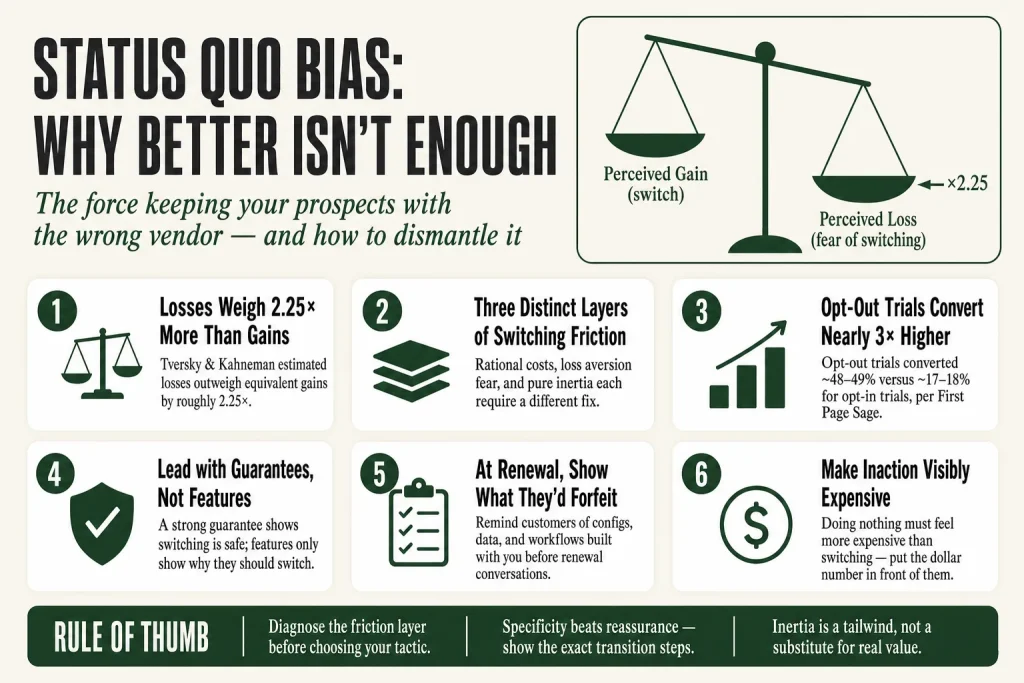
Why the Research Behind Status Quo Bias Should Change How You Sell
The term was coined in a 1988 paper by economists William Samuelson and Richard Zeckhauser, “Status Quo Bias in Decision Making,” published in the Journal of Risk and Uncertainty1(1), 7 to 59. Their core method was elegant: they presented subjects with identical decision scenarios, but framed one option as the status quo and the others as deviations. The option labeled as the default was chosen far more often, not because it was any better, but simply because it was framed as the existing state of affairs.
Their paper also examined real-world field data, including university health plan enrollment records. One plan with significantly more favorable premiums and deductibles was gaining ground quickly among new employees, who had no existing attachment. Among existing employees already enrolled in a different plan, it barely moved. The plans were the same plans. The only variable was whether the person was choosing from scratch or departing from an existing arrangement. That gap cannot be explained by rational preference.
Samuelson and Zeckhauser categorized the psychological roots of the bias into several buckets: loss aversion, sunk cost commitment, cognitive consistency (the discomfort of contradicting a past decision), and simple preference for the familiar. These are not independent. They tend to compound.
The loss aversion angle is the most important for operators to understand, because it tells you exactly why a feature comparison backfires. Kahneman and Tversky’s prospect theory, published in Econometrica47(2), 263 to 291, in 1979, established that losses loom larger than gains. Tversky and Kahneman later estimated the specific coefficient in “Advances in Prospect Theory: Cumulative Representation of Uncertainty,” published in the Journal of Risk and Uncertainty5, 297 to 323, in 1992: a median loss-aversion parameter (lambda) of approximately 2.25, meaning losses weigh roughly 2.25 times as heavily as equivalent gains in the value function. So when a prospect evaluates whether to switch, they are not comparing what they’ll gain from your product against what they currently have. They are comparing what they’ll gain against what they might lose: the familiarity, the sunk training time, the existing integrations, the relationships with their current rep, and the possibility that the switch goes badly and they own that decision. The deck is structurally stacked against you as a challenger, before a single meeting takes place. Knowing the mechanism tells you where to push: not on the gain side of the ledger, but on the loss side, by making the imagined downside of switching smaller.
Richard Thaler coined the related concept of the endowment effect in his 1980 paper “Toward a Positive Theory of Consumer Choice,” published in the Journal of Economic Behavior and Organization1(1), 39 to 60. The implication is direct: the incumbent’s product, whatever its objective quality, is already owned by the customer. That ownership inflates its perceived value, independent of any rational assessment. For operators, this means you are always arguing against an inflated baseline. The customer doesn’t see their current vendor’s product at market value. They see it at ownership value, and those are different numbers.
The Three Layers of Status Quo Bias Every Operator Should Separate
Operators who lump all switching reluctance together as “people resist change” end up picking tactics at random. The reluctance has distinct layers, and the fix for each one is different. Misidentify the layer, and your intervention makes no difference or makes things worse.
Layer 1: Rational Switching Costs
Some of what looks like bias is actually arithmetic. Data migration takes real hours. Staff need real training. Contracts have real exit penalties. These are not cognitive distortions; they are legitimate costs, and treating them as irrational is condescending to the prospect. The operator’s job here is to make the math visible and favorable, not to persuade the prospect that the costs don’t exist. Absorbing onboarding fees, providing migration assistance, offering a parallel-run period, or structuring a phased transition are all direct responses to this layer. They work because they address a real problem.
Layer 2: Loss Aversion and the Fear of a Bad Outcome
Separate from the actual costs is the imagined risk. The prospect pictures a scenario in which the switch goes wrong: data doesn’t transfer cleanly, service dips during transition, they look bad to their own boss for recommending the change. Because losses loom larger than gains in human judgment, this fear is not proportionate to the actual probability. A prospect might intellectually know that a migration is low-risk while still feeling viscerally reluctant.
The correct response here is risk reversal: guarantees, pilot programs, phased rollouts, public case studies from customers who made a similar switch. What you’re doing is lowering the emotional stakes, not just the practical ones. A strong guarantee does not just protect the customer if things go wrong; it signals confidence in a way that recalibrates the fear response before anything has gone wrong.
Layer 3: Pure Psychological Inertia
Even after you’ve reduced the actual costs and addressed the imagined risks, some share of prospects still won’t move. This is what Samuelson and Zeckhauser called the “pure” status quo bias: preference for the current state that cannot be explained by any rational calculation. The mental energy required to decide, evaluate, and commit to a new path feels like a cost in itself. Defaults exert a gravitational pull.
The operator’s move here is to reframe inaction as a choice with consequences, not a neutral state. Doing nothing is not safe; it carries its own costs and risks. Some of those costs are financial (the gap between your pricing and theirs over time), some are operational (a problem the prospect’s incumbent is not solving), and some are reputational (competitors who already made the switch are gaining ground). Making those costs visible and vivid shifts the reference point. The question stops being “should I switch?” and starts being “can I afford to stay?”
How Status Quo Bias Shows Up in Real Operator Situations
The abstract framing is useful. The concrete patterns are more useful. Here is where most small-business operators encounter this force, often without having a name for it.
The Comparison Sale That Stalls
You’re in a competitive replacement scenario. The prospect requests a proposal, reviews it, says “it looks great,” and then goes quiet. Weeks pass. They renew with the incumbent on a one-year extension “just to give us time to properly evaluate things.” This is status quo bias in its purest form. The prospect’s decision to extend is not really a decision to stay. It’s a decision to avoid the switching decision for another year. The correct counter is to make the cost of that extension explicit, and to reduce what switching actually requires so the activation energy drops.
The Feature-by-Feature Comparison Trap
When you try to win on superiority alone, you’re implicitly conceding that the burden of proof is on you as the challenger. That is exactly the terrain status quo bias wants you to fight on. Every new feature you present is another thing the prospect has to evaluate, another thing that could be wrong in ways they haven’t thought of yet. The feature list makes switching feel more complex, not simpler. Better to pick one decisive advantage and make the cost of staying vivid. Oatly didn’t out-spec dairy milk. They made sustainability stakes feel urgent enough that staying with the incumbent (conventional dairy) felt like a vote for something the customer didn’t want to be associated with.
The Incumbent’s Advantage in Renewals
If you are the incumbent, you have the bias working for you at renewal time. The question is whether you’re actively reinforcing it or accidentally switching it off. Auto Trader, the UK’s leading car marketplace, faced a situation where vehicle retailers resented the platform’s pricing power and were increasingly aware of emerging competitors. The Behaviours Agency’s campaign for Auto Trader deliberately exploited status quo bias: rather than introduce new inducements, it reframed the value that retailers were already extracting from their existing subscription and what they’d risk forfeiting by leaving. The message was not “here’s something new” but effectively “here’s how much of what you already have depends on staying.” That is status quo bias deployed as a retention tool.
Default Settings and Trial Mechanics
This is where operators often leave money on the table without realizing it. Opt-out free trials, where a user enters payment details upfront and is auto-charged unless they cancel, work partly because of status quo bias. First Page Sage’s SaaS Free Trial Conversion Rate Benchmarksdrawn from 86 SaaS companies (71% B2B, 29% B2C) tracked from Q1 2022 through Q3 2025 and published September 2025, found that opt-out trials converted at approximately 48 to 49% trial-to-paid via organic traffic, compared to approximately 17 to 18% for opt-in trials where no card is required. Those figures describe meaningfully different populations at the top of the funnel: opt-out trials drew roughly 2.5% of organic visitors into a signup, while opt-in trials drew roughly 8.5%. In other words, opt-out funnels filter harder at entry and lighter at conversion; opt-in funnels do the reverse. Neither is strictly better. The right model depends on your volume economics and your appetite for a narrower but more committed funnel. The ethical version of either model is making the trial long enough to generate real value and making cancellation genuinely easy. The exploitative version is obscuring the billing and making cancellation require a phone call. The first builds a real customer. The second builds a chargeback.
Pricing Structure and the Default Tier
When you present pricing options, the tier you present as the “standard” or default is the one most prospects anchor to, independent of price. This is status quo bias applied to the choice set itself. Good-Better-Best structures exploit this deliberately: the “Better” middle tier is often the highest-margin option precisely because it functions as the implicit default. Operators who don’t think about which option reads as the status quo within their own offer are leaving the default to chance.
Putting this to work? The ideas in the Canon are the foundation under the tactical playbook in Build a Complete Marketing Department. Grab the free companion kit at mmsvegas.com/resources.
Using Status Quo Bias to Protect What You’ve Already Won
Most of the conversation about this concept is framed from the challenger’s perspective: how do you overcome it? But if you are an established provider, the bias is working for you, and operators who fail to recognize this tend to disrupt it accidentally.
The worst thing an incumbent can do at renewal time is behave like a challenger. If you lead with a list of new features, what you’re implicitly communicating is that the relationship isn’t already valuable enough to justify staying. You’ve introduced doubt. You’ve given the customer a reason to compare. The right play at renewal is not a sales pitch. It’s a reminder of what has already been accumulated.
The operating principle: at renewal, remind customers what they’ve built with you. Custom configurations, historical data, trained staff, an established workflow. These are not just switching costs in the abstract. They are real assets the customer has accumulated inside your product. Making those assets vivid in renewal conversations shifts the reference point from “what do I want going forward” to “what would I be giving up.”
Loyalty programs that accumulate tier status work on exactly this mechanism. The accumulated points or status tier is an asset the customer now owns. Switching means forfeiting it. Airlines have used this for decades. The small-business equivalent might be a client’s historical reports, their saved preferences, the integrations they’ve built, or simply the working relationship with their account team. These are all things you can make visible and valued before the renewal conversation starts.
One caveat: inertia-based retention has a ceiling. If your product has genuinely deteriorated relative to the market, the bias gives you a window, not a permanent defense. Customers who stay out of pure inertia are your most likely churners the moment a compelling enough alternative reduces the switching friction below their personal threshold. The goal is to compound real loyalty with the bias’s tailwind, not to substitute one for the other.
Five Tactics for Challengers Who Are Losing to Inertia
These are not theoretical. Each one addresses a specific layer of the bias, and an operator should choose based on which layer is actually stalling their deals, not on which tactic sounds most appealing.
1. Make the Cost of Staying Visible
Calculate what the prospect is leaving on the table every month they delay. If your pricing is 20% lower, that is a dollar number, and you can put it in front of them. If their current vendor has a known gap in a capability they care about, quantify what that gap is costing in time, errors, or missed revenue. The goal is to transform the status quo from a neutral resting state into a choice that is actively costing them something. “Doing nothing” has to feel more expensive than switching.
2. Reduce the Migration Surface Area
The fear of switching is usually not about the new product. It’s about the transition. If you can make the migration require less from the prospect, you reduce the perceived activation energy. This can mean: doing the data migration for them, providing a dedicated onboarding contact, offering a parallel-run period where both systems operate simultaneously, or documenting exactly what the transition involves in a one-page process map. Specificity reduces fear. “We’ll handle the migration” is weaker than “here are the four things that happen during your 14-day onboarding, and your team’s time commitment is under two hours.”
3. Lead with Risk Reversal, Not Features
A strong guarantee restructures the prospect’s mental model of what happens if the switch goes badly. They are no longer facing an irreversible commitment. If you can offer a full money-back guarantee for a defined period, a performance guarantee tied to a specific outcome, or a no-questions exit clause in the first 90 days, you are directly reducing the asymmetry that loss aversion creates. Features show why they should switch. A guarantee shows that switching is safe. The second is usually more persuasive to someone whose primary barrier is fear of a bad outcome.
4. Use Proof from Switchers, Not Just Users
Case studies about happy customers matter less to a switching-resistant prospect than case studies about customers who made exactly the transition the prospect is facing. A testimonial that says “we switched from [incumbent] and here’s how the first 60 days went” does more work than a generic satisfaction story, because it speaks directly to the imagined risk. The transition itself is the story the prospect needs to hear. Collect and feature it deliberately.
5. Make a Pilot the Default Next Step
Instead of asking for a full commitment, offer a scoped pilot that proves value without requiring a complete switch. This lowers the perceived stakes to the point where loss aversion no longer dominates. The prospect is not choosing between incumbents; they’re agreeing to a small test. If the pilot is well-designed, the status quo at the end of it is you, and the bias now works in your favor for the full conversion. This is the structural reason product-led growth works: by the time the buyer is making a purchasing decision, they have already accumulated usage and familiarity that makes staying with your product the path of least resistance.
Where Status Quo Bias Is Strongest, and Where It Breaks Down
Not every sales situation involves a strong incumbency effect. Understanding when the bias is at peak strength, and when it matters less, helps you allocate your energy correctly.
The bias is strongest when: the switching costs are real and visible, the category is complex or high-stakes (enterprise software, professional services, healthcare), the prospect has been with the incumbent for multiple years and has accumulated integrations or institutional knowledge, the buyer is personally at risk if the switch goes badly (meaning they own the decision in front of their own organization), and when the prospect has limited time to evaluate alternatives carefully. All of these conditions amplify the “better the devil you know” mentality.
The bias is weaker when: the category is low-stakes and easily reversible, the prospect is new to the category and has no existing attachment, the incumbent has visibly failed in a way the customer is actively aware of (a service outage, a price spike, a lost relationship with a key contact), or when switching costs have been structurally reduced by the market (portable data standards, standardized integrations, government-mandated switching rights in regulated industries). Banking portability regulations in some markets, for example, exist precisely because regulators recognized that status quo bias was preventing competitive markets from functioning. When switching becomes administratively trivial, the bias loses most of its grip.
The bias is also largely absent in first-time purchase decisions. If your prospect has never used a product in this category before, there is no incumbent to protect. This is why new-to-category buyers are easier to convert than switchers, and why market development (reaching customers who have never bought anything in your category) is often a more productive use of a small business’s acquisition budget than head-to-head competitive displacement, depending on the category size.
One more limitation worth naming: the bias does not make an inferior product immortal. It gives an adequate incumbent a time advantage, not a permanent one. When a competitor offers a large enough improvement and reduces switching costs aggressively, the inertia eventually breaks. The cases where incumbents fall tend to involve a challenger who understood the switching friction problem and systematically dismantled it rather than simply being better.
Common Misunderstandings About Status Quo Bias
Misunderstanding 1: “People resist change because they’re irrational or lazy.”
The word “bias” creates the impression that the preference for the status quo is simply a mistake the buyer is making. It is partly that, but it is also partly correct behavior. Switching does carry real costs and real uncertainty. A new vendor might underperform. Training takes real time. The incumbent’s familiarity does have genuine value. The bias is an overweighting of these concerns relative to the gains, not an invention of concerns that don’t exist. Operators who frame the customer as irrational for not switching tend to build condescending messaging that alienates the exact buyer they’re trying to reach.
Misunderstanding 2: “A better product overcomes the bias.”
It doesn’t, not automatically. The bias operates at the decision layer, which is downstream of the evaluation layer. A prospect can fully agree that your product is better and still choose the incumbent, because the perceived risk of switching outweighs the perceived gain. Being better is necessary but not sufficient. What you need is to be better by enough, in a way that is vivid enough, with enough risk reduction, that the switching decision feels worth making.
Misunderstanding 3: “Lower price is the main lever.”
Pricing helps when switching costs are financial, but the dominant costs are usually psychological and operational. Many operators discount aggressively in competitive displacement situations and find that it barely moves the needle, because the prospect’s barrier was never the monthly fee. It was the imagined pain of the transition. Discounting a service the customer is afraid to adopt still leaves the fear intact.
Misunderstanding 4: “This only matters in B2B or enterprise.”
It matters everywhere there is a habit, a subscription, or an existing vendor relationship. Consumer markets show the same pattern: gym memberships that go unused, newspaper subscriptions that survive despite low readership, insurance policies renewed without comparison. The scale is smaller but the structure is identical. For a small service business competing against a customer’s long-standing provider, status quo bias is just as real as it is in a seven-figure software deal.
Misunderstanding 5: “Once a customer chooses you, the bias protects you forever.”
The bias gives you a structural advantage at renewal, but it is not unconditional. If you let your product or service erode, if a key contact leaves, or if a competitor reduces their own switching friction dramatically, the advantage shrinks. The customers most likely to leave despite inertia are the ones who have never achieved real value, who stayed purely out of laziness and are now actively looking for a reason to justify the switch. Real retention comes from real value delivered. Inertia extends the grace period; it does not replace the value.
Common Mistakes
- Running the same post-loss playbook for every lost deal. Status quo bias has three distinct layers (rational cost, loss aversion, pure inertia), and each one requires a different response. Before changing your pitch, categorize your last five losses by the stated barrier. Operational concern points to onboarding clarity. Fear of a bad outcome points to risk reversal. Vague hesitation with no clear reason points to making the cost of staying visible. Applying a pilot offer to a deal that stalled over exit penalties is as ineffective as offering a discount to a deal that stalled over data migration fear. Diagnose first.
- Describing your onboarding in marketing language instead of logistics. Phrases like “seamless transition” and “dedicated support” are what every vendor says, which means they carry almost no weight with a switching-resistant prospect. Replace them with a literal sequence: what happens on day one, what happens in week two, how many hours the client’s team actually needs to commit, and what the go-live moment looks like. Specificity is what makes the transition feel real and survivable rather than abstract and risky. A one-page onboarding map sent alongside your proposal does more for conversion than three pages of feature comparison.
- Cutting price when the prospect’s barrier is operational or emotional, not financial. Price reduction addresses financial barriers, but the majority of switching reluctance in complex or high-tenure accounts is operational or psychological. Before cutting margin, offer to absorb the migration work, propose a parallel-run period, or build a guarantee. If you discount anyway, tie it to something that also reduces friction, like prepaid onboarding support, so you’re solving the actual problem rather than making a scary decision slightly cheaper. Discounting without addressing the fear leaves the fear intact.
- Sending a new-features summary to a customer at renewal time. At renewal, do not send a proposal or a new-features summary. Send a client-specific value summary: what they’ve configured, what problems you’ve resolved together, what it would take to recreate that setup elsewhere. Build this as a template your account team runs 60 days before every renewal date, not as a reactive document when the client signals they’re looking around. Leading with new features implicitly signals the existing relationship isn’t valuable enough to justify staying, which is the opposite of what you want the customer to feel.
- Collecting testimonials only from satisfied customers, not from customers who switched. A satisfied customer story does not address the fear a switching-resistant prospect actually has. What they need to hear is what happened to someone who made exactly the transition they’re considering: which incumbent they left, what the first 60 days looked like, what was harder than expected, and how it resolved. Build a deliberate library of transition testimonials organized by the incumbent the client left. Honest detail about friction during the move is more persuasive than a smooth success story, because it matches the prospect’s mental model and still ends well.
- Skipping the pilot offer and asking for full commitment up front. Design a scoped pilot with a defined success condition before you need it. A good pilot has a fixed duration (30 or 60 days), a specific outcome the prospect can verify, and a clear path from pilot to full contract. At the end of a successful pilot, you are the status quo. The prospect who converts from a pilot is not making a purchase decision; they’re deciding whether to stop something they’ve already started. That is a structurally easier decision to win.
Operator’s Take
Pull your last five losses to an incumbent and ask one honest question for each: what actually stopped them from switching? Not the polite exit line they gave you on the call. If you don’t know, call them. The answers cluster almost every time into one of three buckets: operational hesitation (“the migration sounds complicated”), emotional hesitation (“it’s just not the right time”), or financial hesitation (“the savings don’t justify the disruption”). That diagnosis determines everything that follows. Applying a pilot offer to a deal that stalled over exit penalties is as ineffective as offering a discount to a deal that stalled over data migration fear. Do the diagnosis first.
If the barrier is operational hesitation, the fix is specificity, not reassurance. Write a one-page transition document before your next proposal goes out. Not a deck, not a sales sheet. A literal sequence: what happens on day one, who does it, and how many hours the client’s team actually needs to commit. Something like: kickoff call, 45 minutes; we migrate your data, days two through eight, zero time from your side; training session, 90 minutes; go-live, day 14. That kind of specificity does more for conversion than any feature comparison, because it makes the transition feel like a thing that has happened before and will happen again, not an open-ended risk the prospect is taking on alone. “Seamless onboarding” is what every vendor says. A literal sequence is what a vendor says when they’ve actually done it.
If the barrier is emotional hesitation, build a guarantee you can actually honor and lead with it. Not “we stand behind our work.” A defined performance outcome (if you haven’t achieved X within 90 days, we refund the difference), or a no-questions-asked exit clause for the first 60 or 90 days. The guarantee isn’t primarily a safety net. It’s a credibility signal. It tells the prospect you’ve run this transition before and you’re comfortable betting on it again. That changes the conversation from “will they perform?” to “what’s the downside if they don’t?” If your guarantee is real, the downside is nothing. That is a very different purchase decision.
If the barrier is financial hesitation, do the arithmetic for them. If your pricing is 20% lower, that’s a quarterly dollar number. If the gap your product closes saves time, estimate the hours and multiply by an hourly rate. Put that number in the proposal. “Staying with your current setup costs you approximately $X per quarter” is not pressure. It’s a service. Most prospects haven’t done that math, and doing it for them is part of what they’re evaluating you on.
For incumbents managing renewals: schedule a value summary 60 days before every renewal date. Not a sales pitch, not a new features summary. A short, specific document of what that client has built with you: configurations set up, problems closed, integrations running, estimated hours their team has saved. The goal is to make walking away feel like discarding something they built, not just canceling a subscription. Send something that looks like a re-pitch and you accidentally hand the prospect a reason to compare. Send a value summary and you remind them what’s already at stake. The bias is working for you at renewal. Don’t switch it off.
One thing to push back on: some operators treat status quo bias as permission to make switching artificially hard. Buried cancellation flows. Data locked in proprietary formats. Phone queues where email would do. That’s not using the bias strategically; it’s holding customers at gunpoint, and they leave loudly the moment a competitor handles the friction for them. The version that compounds is delivering real value and making that value visible before the renewal conversation starts. Inertia is a tailwind. It is not, on its own, a business model.
Used in
- ✓ Build a Complete Marketing Department
Used to structure competitive acquisition campaigns around switching friction reduction rather than feature superiority, specifically in messaging, offer design, and onboarding sequences. - ✓ The Missing Manual for FunnelKit
Applied in designing trial-to-paid funnel logic, default tier selection, and renewal automation sequences that reinforce the customer’s existing investment rather than re-pitching the product. - ✓ The Missing Manual for Make
Used to build automated workflows that surface customer usage history and accumulated value ahead of renewal dates, reducing churn by making the cost of switching visible before the customer goes looking.
FAQ
What is status quo bias in plain terms?
It is the documented tendency to prefer the current situation over a better alternative, simply because it is the current situation. The preference is not random; it is driven by loss aversion, familiarity, and the perceived effort of change.
Who discovered status quo bias?
Economists William Samuelson and Richard Zeckhauser named and documented it in a 1988 paper titled ‘Status Quo Bias in Decision Making,’ published in the Journal of Risk and Uncertainty, 1(1), 7 to 59. The underlying psychological mechanisms, particularly loss aversion, were established earlier by Kahneman and Tversky in their 1979 prospect theory work, published in Econometrica.
How is status quo bias different from switching costs?
Switching costs are real, often quantifiable barriers: data migration, contract penalties, training time. Status quo bias is the psychological preference for staying that persists even after those practical costs are removed or made trivial. Both operate simultaneously, which is why reducing switching costs alone sometimes fails to produce a switch.
Does status quo bias affect B2C customers as much as B2B buyers?
Yes. Consumer markets show the same pattern in gym memberships, insurance renewals, banking relationships, and subscription products. The scale of the transaction is smaller, but the psychological structure is identical. Any situation with a habit, an existing provider, or an accumulated relationship will show the effect.
What is the most effective single tactic for overcoming status quo bias?
There is no universal answer because the bias has multiple layers. If the dominant barrier is fear of a bad outcome, risk reversal (a strong guarantee or a no-commitment pilot) is usually the highest-leverage move. If the barrier is perceived effort, absorbing the operational work of switching tends to do more than any messaging change.
Can an operator use status quo bias to protect existing customers?
Yes, and this is underused. At renewal, remind customers of what they have already built with you: configurations, historical data, workflows, relationships. Making those accumulated assets vivid in renewal conversations reinforces the inertia that makes switching away feel costly, which is the same force that works against challengers trying to displace you.
Further reading
- Samuelson, W. & Zeckhauser, R. (1988). “Status Quo Bias in Decision Making.” Journal of Risk and Uncertainty1(1), 7 to 59. The original paper. Worth reading even for non-economists; the investment portfolio and health plan examples are immediately legible to any operator thinking about competitive displacement.
- Kahneman, D. & Tversky, A. (1979). “Prospect Theory: An Analysis of Decision under Risk.” Econometrica47(2), 263 to 291. The foundational work on loss aversion that explains why the status quo carries so much psychological weight. Dense, but the value function curve alone is worth the read.
- Tversky, A. & Kahneman, D. (1992). “Advances in Prospect Theory: Cumulative Representation of Uncertainty.” Journal of Risk and Uncertainty5, 297 to 323. Where the specific loss-aversion coefficient (lambda ≈ 2.25) was estimated empirically. This is the source for the “losses weigh roughly twice as much as gains” shorthand used throughout this page.
- Thaler, R. (1980). “Toward a Positive Theory of Consumer Choice.” Journal of Economic Behavior and Organization1(1), 39 to 60. Where the endowment effect was introduced; directly relevant to understanding why customers overvalue what they already own.
- Thaler, R. & Sunstein, C. Nudge (2008). The practical application of default effects and opt-out design to real-world decision architecture; the chapters on defaults are the most operator-useful sections.
Sources:
Primary research grounding this page: Samuelson, W. & Zeckhauser, R. (1988), “Status Quo Bias in Decision Making,” Journal of Risk and Uncertainty1(1), 7 to 59 (confirmed via Richard Zeckhauser’s Harvard Kennedy School faculty page and the Springer DOI record 10.1007/BF00055564). Kahneman, D. & Tversky, A. (1979), “Prospect Theory: An Analysis of Decision under Risk,” Econometrica47(2), 263 to 291. Loss-aversion coefficient (median lambda ≈ 2.25) from Tversky, A. & Kahneman, D. (1992), “Advances in Prospect Theory: Cumulative Representation of Uncertainty,” Journal of Risk and Uncertainty5, 297 to 323. Richard Thaler’s endowment effect: “Toward a Positive Theory of Consumer Choice” (1980), Journal of Economic Behavior and Organization1(1), 39 to 60 (confirmed via Nobel Prize committee documentation, 2017). University health plan enrollment data reported in Samuelson & Zeckhauser (1988); characterized in this page as paraphrase from the original paper, not direct quotation. Opt-in vs. opt-out trial conversion benchmarks: First Page Sage, SaaS Free Trial Conversion Rate Benchmarksdrawn from 86 SaaS companies (71% B2B, 29% B2C), Q1 2022, Q3 2025, published September 2025. The body text cites these figures as approximate ranges (opt-out trial-to-paid: approximately 48 to 49%; opt-in trial-to-paid: approximately 17 to 18%; opt-out visitor-to-trial: approximately 2.5%; opt-in visitor-to-trial: approximately 8.5%) rather than as precise decimals, reflecting normal variation across the sources that report from this dataset. Note: First Page Sage is a marketing agency reporting on its own client base; these figures describe that client population (heavily B2B SaaS), not the SaaS market as a whole. Auto Trader retention campaign context: The Behaviours Agency case study (thebehavioursagency.com/status-quo/), describing a campaign that used status quo bias framing to retain vehicle retailers by making the value of their existing subscription vivid against emerging competitor pressure. All editorial judgments, the three-layer diagnostic framework (rational switching costs, loss aversion, pure psychological inertia), and all application content are original to The Operator’s Canon.
Brian Kasday spent forty years in direct-response marketing before rebuilding the whole operation as a one-person shop. He writes The Operator’s Library — including “Build a Complete Marketing Department” — for operators who’d rather build it themselves than wait on someone else.
Build the department these ideas describe. The free companion kit: mmsvegas.com/resources.
More The Operator's Canon guides
Free · Operator Toolkit
Want the tools, not just the guide?
Get the free operator toolkit — templates and checklists for the systems you actually run, plus a note when this guide changes.
Get the free toolkit →