
The 30-second answer
- Calculate your churn rate first. Divide customers lost in a period by customers at the start of that period. You can’t fix what you can’t measure.
- Find the real reason people leave. Run a short exit survey or make a single follow-up call. Generic guesses waste your effort.
- Fix your onboarding before anything else. Research consistently shows a large share of churn traces back to the first 30 to 90 days. Get customers to a first win fast.
- Watch for warning signs proactively. Declining email opens, reduced purchase frequency, and support spikes all precede cancellation by weeks.
- Segment your at-risk customers and contact them personally. A short, direct email from you beats any automated sequence.
- Give loyal customers a reason to stay, not just a discount. Early access, recognition, and referral incentives build stickiness without training customers to wait for deals.
- Handle involuntary churn separately. Failed payments are a different problem with a different fix: automated card-update retries and payment reminders.
Take this fix into your next scenario. The free Builder’s Companion Kit collects the checklists and templates that pair with this guide — so next time, you start from a template, not a blank page. Grab it free →
- What Churn Actually Costs You (The Math Is Worse Than You Think)
- Voluntary vs. Involuntary Churn: Two Different Problems
- Why Customers Leave (And Why Your First Guess Is Usually Wrong)
- How to Spot Customers Who Are About to Leave
- Fix Your Onboarding First: Where Most Churn Is Actually Born
- How to Segment and Reach At-Risk Customers Before They Cancel
- Build Stickiness: Loyalty, Referrals, and the Customers Worth Fighting For
- Price, Expectations, and the Pre-Sale Decisions That Drive Post-Sale Churn
- A Worked Example: How to Reduce Customer Churn in 30 Days With What You Already Have
- FAQ
Knowing how to reduce customer churn is one of the highest-ROI moves you can make as a small business owner, and most operators ignore it entirely. They keep pouring money into ads, cold outreach, and launch sequences while the back door swings wide open. Acquiring a new customer costs 5 to 25 times more than keeping an existing one, according to research from Bain & Company (via Harvard Business Review). Meanwhile, a 5% improvement in retention can raise profits by 25% to 95%. Those numbers should stop you in your tracks. If you’re spending 80% of your marketing energy on acquisition and almost nothing on keeping the customers you already have, you’re swimming upstream. This guide covers why customers leave, how to see it coming, and the fixes a solo operator can actually put into practice this week.
What Churn Actually Costs You (The Math Is Worse Than You Think)
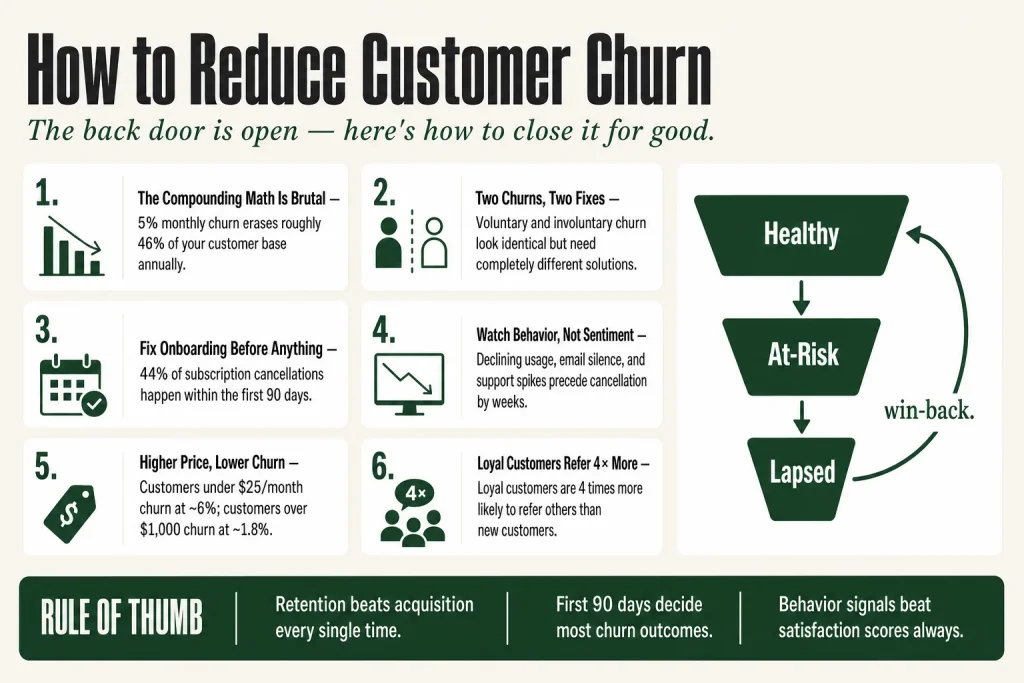
Customer churn rate is the percentage of customers who cancel or don’t renew over a defined period. The formula is simple: divide customers lost during the period by customers at the start of the period, then multiply by 100. A 5% monthly churn rate sounds harmless. It isn’t. Run the compounding math and a 5% monthly rate translates to roughly a 46% annual loss of your customer base. That means you’d need to replace nearly half your customers every year just to stay flat.
Acquisition costs have risen sharply. Multiple converging analyses across ecommerce and B2B sectors put average customer acquisition costs up 40% to 60% between 2023 and 2025, driven by ad competition, privacy regulation changes, and attribution complexity. Phoenix Strategy Group’s CAC benchmark data and independent analyses from LoyaltyLion, Stealthagents, and Ringly.io all arrive at a consistent range, though exact figures vary by industry and channel. What’s unambiguous: retention costs have grown far more slowly over the same period, which means every customer you keep is worth more relative to what it would cost to replace them. Existing customers also have a 60 to 70% chance of buying again from you, compared to a 5 to 20% chance with a prospect who’s never heard of you. You’re not just saving money by reducing churn. You’re selling into far better odds.
One more number worth keeping in your head: Bain & Company research on online retail shoppers found that customers in months 31 to 36 spend on average 67% more than they did in their first six months. Churn cuts off that compounding before it even starts.
Voluntary vs. Involuntary Churn: Two Different Problems
Before you pick a fix, you need to know which type of churn you’re dealing with. They look identical in your subscriber count but have completely different causes.
Voluntary churn is when a customer consciously decides to leave. They found a better option, felt the value didn’t match the price, got frustrated with the experience, or simply didn’t use the product enough to justify keeping it. This is the type most people think of when they say churn, and it’s the one that responds to the retention strategies in this article.
Involuntary churn is when a customer gets removed from your list because of a failed payment, an expired card, or a billing error, not because they chose to go. Research across subscription businesses consistently puts involuntary churn at around 1% monthly. That sounds small until you realize it’s entirely preventable. If your email platform or billing tool supports automated card updaters and intelligent payment retries, turn them on. This is low-effort, high-return cleanup work. Treat it separately from your voluntary churn analysis or you’ll confuse the two and waste effort on the wrong fixes.
A quick diagnostic: look at your last 20 churned customers. How many cancelled intentionally versus had a payment fail and never come back? The split tells you where to focus first.
Why Customers Leave (And Why Your First Guess Is Usually Wrong)
Most small business owners guess “price” when asked why customers leave. Sometimes that’s true. More often, price is the reason a customer gives because it’s the easiest one to say out loud. The real reasons tend to be messier: they never got a clear first win from your product, the onboarding was confusing, support felt slow, or they didn’t feel like you noticed them until they were already gone.
The research on this is consistent. Poor onboarding ranks among the leading drivers of churn, and multiple sources point to the first 30 to 90 days as the highest-risk window for early departures. One widely cited finding from researcher Esteban Kolsky, referenced by OnRamp and SundaySky among others, holds that solving issues during a customer’s first interaction can prevent up to 67% of churn. That’s a different framing from saying 67% of all churn originates in the onboarding period, but the underlying point is the same: friction in those first weeks is where most retention battles are won or lost. That’s a solvable problem, and it’s cheaper to solve than running another ad campaign.
Common voluntary churn causes to investigate:
- No first win during onboarding. Customers who don’t understand your product’s value within the first week are highly likely to leave. Speed to value is the single strongest predictor of long-term retention.
- Expectation mismatch. Your marketing promised X and the product delivered Y. This one is often a copywriting problem, not a product problem. The fix starts before the sale.
- Neglect. The customer bought, got a welcome email, and then heard nothing useful for three months. Silence reads as indifference.
- Price without perceived value. If a customer can’t articulate what they’re getting for their money, a competitor’s offer will always look more attractive, even at a higher price.
- Friction. High-effort experiences correlate strongly with churn. When customers have to fight to get value, they start looking for easier alternatives.
The only way to know which of these applies to your business is to ask. A short customer survey sent within a week of cancellation will tell you more than any amount of theorizing. Call when you can. A five-minute conversation gives you context a rating scale never will.
How to Spot Customers Who Are About to Leave
Most customers don’t tell you they’re leaving. They quietly stop logging in, stop opening emails, and one day the cancellation lands in your inbox. The good news: the average B2B customer decides to leave 30 to 60 days before they actually submit the request. The signals are there. You just need to know what to look for.
The strongest behavioral warning signs, roughly in order of how early they appear:
- Declining usage or purchase frequency. A sustained drop of 30% or more against a customer’s own baseline is a reliable early signal. Compare each customer to their own history, not to your average user, because usage levels vary enormously between accounts.
- Email disengagement. A customer who used to open your emails and now ignores them is drifting. Falling open rates at the segment level can also flag a systemic problem. See the guide on fixing low email open rates if that’s what you’re seeing across the board.
- Support spike followed by silence. A spike in support tickets signals frustration. Then, if the tickets stop entirely, that’s often worse: the customer has given up on getting help and is evaluating their exit. Around 97% of churning customers never contact support before they leave. The quiet ones are usually the ones heading out.
- Downgrade requests. A customer dropping to a lower tier or asking about pausing is rarely just a budget issue. It’s a signal they’re not getting enough value to justify the current price.
- NPS or satisfaction score decline. A drop of more than 10 points in a single quarter warrants a personal outreach. Don’t wait for the score to hit zero. By the time it does, the decision is usually already made. The stronger signal is NPS decline combined with usage decline in the same quarter.
You don’t need a complex dashboard to track this as a solo operator. A simple spreadsheet that logs each customer’s last purchase date, email open trend, and most recent support interaction will surface most of the risk you need to act on. Check it once a month.
Fix Your Onboarding First: Where Most Churn Is Actually Born
If you could only do one thing to reduce customer churn, fix your onboarding. The data on this is unusually consistent across industries. Customers who achieve a clear first success early in the relationship retain at dramatically higher rates than those who don’t. Multiple sources, including time-to-value research compiled by SaaS Mag and cited across 2025 and 2026 onboarding benchmarks, find that customers who reach a meaningful first win within 10 to 14 days retain at 80% or higher at 12 months. Those who don’t hit that milestone within 30 days retain at just 35 to 50%. That’s not a rounding error. That’s an entirely different business outcome depending on what happens in the first week or two.
According to Rocketlane’s 2025 customer onboarding report, customers who had a smooth onboarding experience were 53.5% less likely to churn. Smooth doesn’t mean complicated or elaborate. It means the customer quickly understood what they bought, knew what to do next, and got a result they could point to.
For a solo operator, a strong onboarding sequence doesn’t have to be a six-week course. It needs three things:
- A clear next step immediately after purchase. Not a PDF library. One specific action that gets them to their first result.
- A short check-in at day 7 or 14. A plain-text email asking if they hit a snag. This catches silent strugglers before they quietly quit.
- A structured welcome email sequence that delivers value in stages. Each email should move the customer one step closer to their goal, not just recap features.
One number worth noting: 44% of subscription cancellations happen within the first 90 days (Marketing LTB, via SundaySky 2026 onboarding statistics compilation). That means almost half your churn problem lives entirely inside your onboarding window. Fixing that window is more impactful than any win-back campaign you could run later.
How to Segment and Reach At-Risk Customers Before They Cancel
Once you can identify who’s at risk, the next move is to act on it before they cancel, not after. Winning someone back after cancellation is possible but costs more effort and rarely rebuilds the same trust. The intervention is most effective when it happens while the customer is still on the fence.
Start by segmenting your customer list into three rough buckets: healthy (actively engaged, recent purchase), at-risk (declining engagement, no recent purchase, or recent support frustration), and lapsed (haven’t purchased or engaged in a defined window that you set based on your normal purchase cycle). This is a core segmentation task. The guide on segmenting your email list covers the mechanics if you haven’t done this before.
For at-risk customers, the most effective outreach is a short, direct, personal-sounding email from you. Not a promotion. Not a feature announcement. A genuine check-in: “Hey, I noticed you haven’t used in a while. Are you running into anything I can help with?” This is not the place for your best copywriting. It’s the place for honesty.
What to offer at-risk customers:
- A direct path to solving whatever friction they’re hitting (a call, a walkthrough, a resource).
- A pause option if the issue is temporary (budget, timing). Pausing is far cheaper than losing the customer entirely and re-acquiring them later.
- A small but meaningful incentive to re-engage, tied to value, not just a discount. A discount trains customers to wait for the next one. A bonus session, an extended feature trial, or early access to something new creates a different kind of pull.
One note on AI tools here: you can use AI to help draft outreach emails and surface patterns in customer data more quickly than you could by hand. That’s a real time-saver. But the thinking behind the work stays with you entirely. Deciding who warrants a personal touch, what to offer, and whether a usage dip is a real signal or just seasonal noise: those are your calls, not the tool’s. AI speeds up execution. It doesn’t interpret what the data means for your specific business, and it doesn’t tell you what to do about it. That part is on you.
Build Stickiness: Loyalty, Referrals, and the Customers Worth Fighting For
Not all customers churn for the same reasons, and not all customers are worth the same effort to save. Before you build out retention programs, spend 30 minutes identifying your best customers: the ones who buy most frequently, refer others, leave positive reviews, and rarely complain. These are the accounts worth building your retention strategy around.
Consistent, proactive communication is one of the clearest levers against churn. Proactive doesn’t mean aggressive. It means you contact customers at meaningful moments without waiting for a problem to surface, and you make it a habit rather than a reaction.
A few stickiness tactics that work without a big budget:
- Referral program. Loyal customers are 4 times more likely to refer your business to others than new customers are. A simple, clearly communicated referral incentive builds retention and acquisition at the same time. The guide on building a referral program for service businesses walks through how to set one up without overcomplicating it.
- Recognition before discounts. Acknowledge milestones: first anniversary, tenth order, a referral they sent. A personal note costs nothing and signals that you notice. Discounts have their place, but they’re not the only retention lever, and they’re the most expensive one.
- Community or peer access. A group, forum, or even a simple customer-only Q&A call gives customers a connection that goes beyond the transaction. That connection raises the switching cost in a way that’s hard to replicate.
- Consistent, useful communication. A regular email that delivers actual value, not just promotions, keeps you present without being pushy. This is where your email cadence and content do real retention work. If you haven’t sorted out how often to email your list, that’s worth sorting before you try to build a loyalty sequence on top of a broken cadence.
Price, Expectations, and the Pre-Sale Decisions That Drive Post-Sale Churn
A lot of churn is set before the customer even pays you. If your marketing attracts buyers who aren’t a good fit, or if your copy overpromises what your product delivers, the churn clock starts ticking on day one. The fix here isn’t in your retention workflow. It’s upstream in your positioning, your targeting, and your sales copy.
Two specific pre-sale decisions that drive post-sale churn:
1. Attracting the wrong customers. A customer who signed up because of a heavy discount, a vague promise, or a mismatch between their actual need and your actual product will almost always churn. Tighter targeting, even if it slows acquisition, produces better retention. If you’re not sure whether your marketing is pulling in the right people, a marketing audit will surface that gap pretty quickly.
2. Underpowered pricing. Counter-intuitively, customers who pay more tend to churn less. Subscription data consistently shows that customers paying under $25 per month churn at roughly 6% monthly, while customers paying over $1,000 churn at about 1.8%. Higher price signals higher commitment and forces the customer to extract value. It also gives you more margin to invest in keeping them. If you’re competing on low price, you’re also competing for the customer segment most likely to leave. The guide on how to price your product or service covers how to think through price without just guessing.
The honest caveat: pricing strategy changes take time to affect your churn numbers, and not every business has the positioning to move upmarket immediately. But if your churn is stubbornly high despite solid onboarding and retention touchpoints, the problem may be in who you’re selling to and at what price, not in your post-sale execution.
A Worked Example: How to Reduce Customer Churn in 30 Days With What You Already Have
Here’s a concrete 30-day sequence for a solo operator who’s never done structured churn work before. No new tools required. No agency.
Week 1: Measure and diagnose.
- Calculate your churn rate for the last 3 months. Customers lost divided by customers at start of period, times 100. Write the number down. If you don’t have clean data, make your best estimate and note the gaps.
- Pull your last 10 churned customers. How many cancelled intentionally? How many had a payment fail? Split them into voluntary and involuntary piles.
- For involuntary churners: check whether your billing platform has a dunning or payment retry setting. Enable it if it’s available. This is usually a single toggle or setting in your payment tool.
- For voluntary churners: send a short 2-question email. “What was the main reason you left?” and “Is there anything we could have done differently?” Even two or three responses will tell you more than you currently know.
Week 2: Segment your active customers.
- Open your email platform or CRM. Sort customers by last purchase date and last email open. Flag anyone who hasn’t engaged in your normal churn window (define this based on your purchase cycle: weekly for subscription, 90 days for quarterly, etc.).
- This is your at-risk segment. Don’t send them a campaign. Send a personal-sounding plain-text email from your own address. Keep it to three sentences: notice, question, offer to help.
- For your healthy segment: send one email that delivers clear value, asks for a referral or review, or teases something they’d want to know about. Feed the relationship while it’s still warm.
Week 3: Fix one onboarding gap.
- Look at your current onboarding flow. Is there a day-7 or day-14 check-in email? If not, write one today. Plain text, first person, one question. Schedule it to go out automatically after purchase.
- Is there a clear “first win” moment in your onboarding? If a new customer came in tomorrow with no prior context, could they reach a meaningful result within 10 days following your current onboarding? If the answer is no, that’s your highest-priority fix.
Week 4: Build a simple retention habit.
- Set a recurring monthly calendar block: 30 minutes to check your at-risk segment, one block to review any churn from the past month, and one note on what you learned.
- Track your churn rate each month going forward. The baseline you set this week becomes your benchmark.
None of these steps require a CRM upgrade, a marketing agency, or an AI tool. They require your attention and one afternoon to set up the infrastructure. The payoff compounds every month you run it.
FAQ
what is a good customer churn rate for a small business
For SMB-focused businesses, an annual churn rate of 8 to 15% is typical, though the target is always lower. Subscription data suggests aiming for 5% annual churn or below as a benchmark for sustainable growth. Your most useful comparison is your own rate over time, not an industry average.
how do I calculate my customer churn rate
Divide the number of customers you lost during a period by the number of customers you had at the start of that period, then multiply by 100. For example, if you started the month with 200 customers and lost 10, your monthly churn rate is 5%. Measure the same period consistently so your numbers are comparable month over month.
why do customers churn even when they seem happy
Customers who give you a 7 or 8 on a satisfaction survey are often the ones who leave quietly. They don’t hate your product, but they’re not committed to it either. Declining usage, infrequent purchases, and low email engagement are better early signals than satisfaction scores alone. Watch behavior, not just stated sentiment.
how can AI help reduce customer churn for small businesses
AI tools can help you draft win-back and at-risk outreach emails faster, spot patterns in customer feedback, and sort through engagement data more quickly than you could by hand. What AI can’t do is decide whether a signal is worth acting on, determine what to offer a specific customer, or tell you whether your onboarding is actually delivering value. The judgment stays with you. The decisions are yours. AI cuts the time you spend on execution work. It doesn’t replace the thinking behind it, and it shouldn’t.
is it worth trying to win back churned customers
Sometimes, but it’s rarely more efficient than preventing churn in the first place. Win-back campaigns work best for customers who left due to timing or budget issues rather than a bad experience. If someone left because of a core product or expectation problem, address that first or you’ll win them back only to churn them again.
what’s the difference between voluntary and involuntary churn
Voluntary churn is when a customer chooses to leave. Involuntary churn is when they’re removed because of a failed payment, expired card, or billing error. They look the same in your numbers but need completely different fixes. Check your billing platform for dunning settings and payment retry automation to address involuntary churn separately.
Sources:
Sources consulted: Bain & Company / Frederick Reichheld research on acquisition vs. retention costs (via Harvard Business Review); Recurly 2025 Subscription Retention Benchmarks; Rocketlane 2025 Report, “The State of Customer Onboarding 2025” (via HubSpot); SundaySky customer onboarding statistics 2026; UserGuiding onboarding research (via SundaySky compilation); Stripe Churn Benchmarks 2025 (via Subjolt); SaaS Capital 2025 SaaS Retention Benchmarks for Private B2B Companies; Focus Digital average churn rate by contract value 2025; Stealthagents customer retention cost statistics 2026 (citing Bain & Company, Forrester); Marmeto at-risk customer churn warning signs research 2026; Chattermill churn early warning system research; OnRamp customer onboarding statistics 2026; Learnybox digital customer onboarding guide 2026; Gainsight Customer Success Index 2025 (proactive communication and retention benchmarks); Phoenix Strategy Group CAC Benchmarks by Channel 2025; LoyaltyLion average CAC in ecommerce 2025; Ringly.io ecommerce customer acquisition cost statistics 2026; Esteban Kolsky churn prevention research (via OnRamp, SundaySky); SaaS Mag time-to-value and retention benchmarks 2026; Marketing LTB customer retention statistics 2025 (via SundaySky).
Brian Kasday spent forty years in direct-response marketing before rebuilding the whole operation as a one-person shop. He writes The Operator’s Library — including “Build a Complete Marketing Department” — for operators who’d rather build it themselves than wait on someone else.
Get the Builder’s Companion Kit — the free checklists and templates that pair with this guide: mmsvegas.com/resources.
This guide handles one marketing job. Build a Complete Marketing Department builds the whole department. See the manual →
More Marketing guides
Free · Marketing Operator Toolkit
Running marketing on your own?
Get the free toolkit — the templates and the expensive mistakes behind a one-person marketing department, plus a note when this guide changes.
Get the free toolkit →